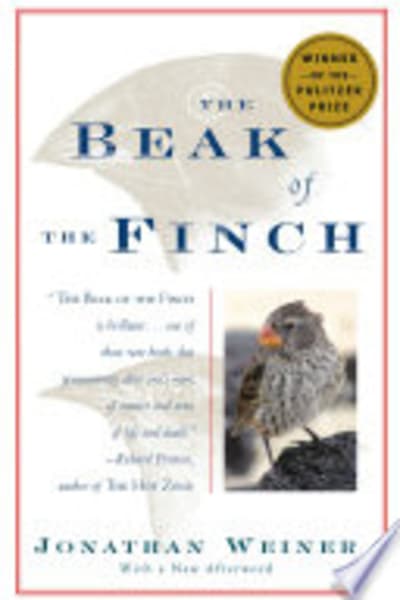
The Beak of the Finch — Book Summary & Review
Last updated:
The Beak of the Finch Summary
On Daphne Major, Weiner organizes The Beak of the Finch around a plain but radical idea: evolution by natural selection can be measured in real time, not inferred after the fact. The Grants—Peter and Rosemary—become the engine of the narrative, and Weiner’s structure alternates between fieldwork details (beak measurements, drought years, breeding cycles) and the conceptual stakes: what counts as evidence when selection is fast enough to watch. One of the book’s most vivid concrete examples is how the finches’ beak depth shifts after specific environmental pressures on the island, letting Weiner show selection acting “by the hour” in a way Darwin could only gesture toward. Weiner also leans hard on the tension between slow-change stories and the Grants’ data-driven insistence that selection can be both strong and immediate.
Weiner’s argument isn’t that Darwin was wrong; it’s that Darwin underestimated the speed and intensity of selection, and the Grants’ long-term study turns that underestimate into a testable claim. The writing has the buoyant clarity people associate with Gould, but Weiner keeps dragging you back to method: why these birds, why Daphne Major, why the measurements matter, and why long observation is the only way to separate chance from selection. If you skim for drama, you’ll miss the point; if you stick with the logic, you’ll start thinking like a field scientist. The honest limitation: the book does not teach you how to do evolutionary analysis yourself, and it can feel repetitive if you want fewer logistics and more sweeping theory.
After finishing, I kept thinking about how Weiner makes the case that “real-time evolution” is not a slogan—it’s a dataset, and Weiner’s respect for that dataset is exactly what makes the Grants’ work land.
Key Takeaways from The Beak of the Finch
-
1
Daphne Major: A single island population where weather and feeding pressures change quickly enough to track selection directly.
-
2
Beak depth measurements: Weiner treats recurring measurements as the bridge between bird behavior and evolutionary explanation.
-
3
Long-term observation: The Grants’ decades of fieldwork prevent cherry-picking and let patterns survive drought-to-drought variation.
-
4
Natural selection by the hour: The book argues selection can be immediate, not merely slow background pressure over centuries.
-
5
Peter and Rosemary Grant: Their partnership and methods embody how careful sampling turns a story into evidence.
Who Should Read This
If you’ve been frustrated by evolution books that rely on fossils and big-picture claims without showing how scientists verify them, read this. Someone who wants to understand how field data can force a rethink of Darwin’s timeline will get real satisfaction here.
Who Shouldn't Read This
If you only want high-level evolutionary theory with minimal experimental or field-method detail, you’ll find the logistics heavy. If you’re hunting for a tidy how-to for analyzing evolutionary selection yourself, Weiner won’t deliver that kind of instruction.
Editor's Verdict
The single best thing this book does is make the Grants’ real-time selection argument feel concrete through Daphne Major’s drought-driven beak shifts and careful measurement logic. The limitation is that Weiner never turns the research process into a transferable, step-by-step guide, so method-curious readers may want more than narrative. This hits hardest for anyone who’s just burned out on vague popular science and needs a specific, data-grounded reason to believe evolution can be observed, not merely described.
Ready to read The Beak of the Finch?
Get your copy on Amazon today.
The Beak of the Finch — Frequently Asked Questions
About Jonathan Weiner
Jonathan Weiner is an American science writer and journalist. He has written extensively about biology, evolution, and medicine, drawing on reporting and interviews with researchers. He is credible on the topic of Darwin’s finches because The Beak of the Finch is based on years of direct coverage of fieldwork and scientific debates surrounding Peter and Rosemary Grant’s long-term study of finch evolution on Daphne Major. Other notable works include The Next One Hundred Years and Long for This World.