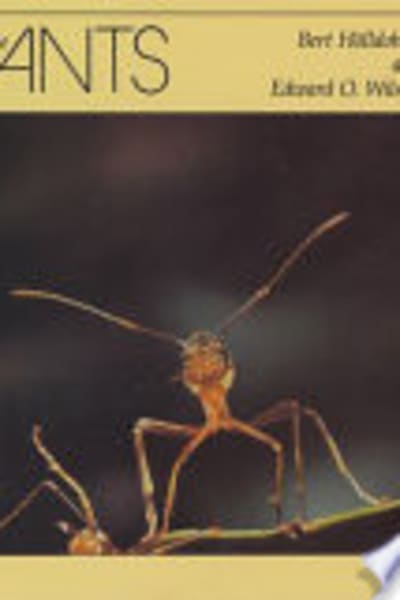
The Ants — Book Summary & Review
by Bert Hölldobler and Edward O. Wilson
Last updated:
The Ants Summary
Hölldobler and Wilson organize The Ants around a sweeping grid—anatomy, physiology, social organization, ecology, and natural history—so you always know where the next layer of “how ants work” fits. The book’s distinctive move is to treat ant society as biology with measurable parts: caste differentiation, communication, colony-level decision-making, and the ecological pressures that keep those systems from collapsing. In the early sections, they walk through basic anatomy and then keep returning to how form enables function, especially in workers’ sensory equipment and the ways pheromones and other signals coordinate group behavior.
One of the most memorable through-lines is their account of social organization, where Hölldobler’s emphasis on specialization meets Wilson’s broader evolutionary framing. They don’t merely list behaviors; they connect them to constraints—energy budgets, nest architecture, and predation—so the “why” keeps showing up alongside the “what.” The book also leans hard into concrete ecological examples, from colony expansion and resource competition to the role of ants as predators, scavengers, and ecosystem engineers.
A specific strength is how they treat the diversity of ant life as a coherent scientific problem, not a chaotic museum of curiosities. Even when you skim, the structure keeps dragging you back to the same questions: what selects for this behavior, how does the colony maintain it, and what goes wrong when conditions change?
Honest limitation: this is not a narrative about ants you can read for entertainment. It’s dense, reference-heavy, and written for readers who want taxonomy-level detail and evolutionary argumentation; if you’re hoping for a breezy “nature documentary” tone, you’ll feel punished by the academic thoroughness.
Key Takeaways from The Ants
-
1
Caste differentiation explains how worker roles aren’t vibes; they’re biologically produced specializations shaped by colony needs.
-
2
Pheromone communication maps signals to outcomes, showing how chemical cues coordinate foraging, defense, and recruitment at scale.
-
3
Colony-level selection treats the “unit” as the whole society, not just individual ants, when explaining evolution of behavior.
-
4
Ecological constraints keep behavior grounded, linking nest conditions, resources, and predation pressure to social structure.
-
5
Natural history synthesis forces pattern-spotting, using many species to argue that ant diversity follows repeatable rules.
Who Should Read This
Someone who keeps getting pulled into ant videos but wants the real scientific machinery—caste biology, signaling, and ecology—will be satisfied. If you’re someone who reads to build knowledge systems and you’re okay with dense, cross-referenced writing, this will reward you.
Who Shouldn't Read This
If you want a smooth, story-driven nature book with minimal terminology, you’ll find The Ants slow and demanding. If you only want a quick overview of “cool ant facts,” the exhaustive scope will feel like homework with no off-ramp.
Editor's Verdict
The single best thing this book does is its structured, multi-lens explanation of social organization—how Hölldobler and Wilson repeatedly connect caste, signaling, and ecology into one argument. The real limitation is that it’s relentlessly technical and survey-like, with little narrative relief and no shortcuts for casual readers. Anyone mid-career questioning whether they still want “serious knowledge” will feel the strongest pull while reading the sections that tie behavior to evolutionary constraints and colony function.
Ready to read The Ants?
Get your copy on Amazon today.
The Ants — Frequently Asked Questions
About Bert Hölldobler and Edward O. Wilson
Bert Hölldobler is a German biologist and entomologist known for research on social insects, especially ants, including communication, behavior, and colony organization. Edward O. Wilson was an American biologist and naturalist who studied ants and other insects and helped found modern sociobiology. Both are credible due to decades of peer-reviewed field and laboratory research on ant biology and social behavior. Notable works include Wilson’s The Ants and Hölldobler and Wilson’s The Superorganism.