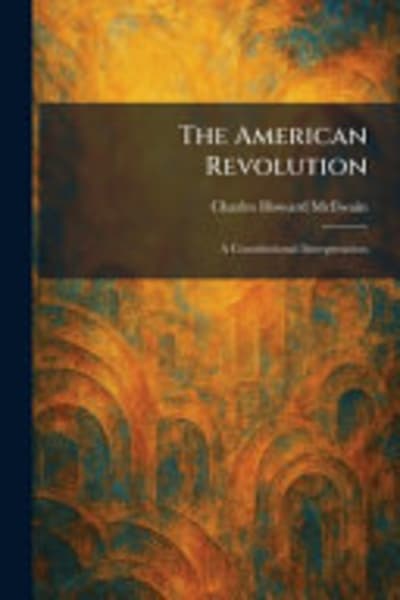
The American Revolution: A Constitutional Interpretation — Book Summary & Review
Last updated:
The American Revolution: A Constitutional Interpretation Summary
In The American Revolution: A Constitutional Interpretation, Charles Howard McIlwain frames the conflict as a constitutional quarrel over Parliament’s reach, not mainly a social explosion, and he keeps returning to the Crown–Parliament–colonies triangle to prove it. Early on, McIlwain lays out his core method: treat 1775–1776 arguments as legal claims about authority, sovereignty, and the status of the “dominions,” then track how those claims hardened into the Declaration of Independence. One concrete example is his sustained focus on whether Parliament could legislate for subjects across the Atlantic—he reads colonial resistance as a dispute about lawful constitutional power, not mere taxation resentment. He also leans hard on precedent from the “English constitution,” treating familiar constitutional doctrines as the language colonists used to justify resistance, which is why the book’s structure feels like a guided march through legal categories rather than a narrative of battles.
McIlwain’s best sections are where he connects theory to timing: the way changing interpretations of sovereignty narrowed the space for compromise, until independence became the only constitutionally coherent option. He repeatedly returns to the idea that the Revolution becomes intelligible once you see it as an argument about the empire’s legal architecture, and he does so with enough specificity that you can almost map colonial pamphlet logic onto his steps. That said, McIlwain’s approach is narrow in another direction: he doesn’t try to synthesize every economic, cultural, or military driver of the war, and he’s not interested in telling you what ordinary colonists felt. If you want a broad, vivid Revolution story or a modern, accessible constitutional-law primer, McIlwain will feel austere and occasionally stubborn.
Key Takeaways from The American Revolution: A Constitutional Interpretation
-
1
Parliamentary authority framework: McIlwain treats the Revolution as a fight over whether Parliament could legislate for colonists across the Atlantic.
-
2
The “dominions” status: He uses dominion vocabulary to explain how colonies tried to map themselves onto the British imperial constitutional order.
-
3
English constitution precedents: McIlwain argues colonists borrowed familiar constitutional doctrines, so their claims weren’t invented from scratch.
-
4
Sovereignty interpretations: He tracks how shifting sovereignty readings narrowed options until independence became legally coherent.
-
5
Crown–Parliament–colonies triangle: The book’s structure keeps legal relationships central, making political events look like constitutional logic in motion.
Who Should Read This
Someone who’s been frustrated by Revolution histories that reduce everything to taxes, economics, or “inevitable independence” should read McIlwain to see the legal thread. If you’re wrestling with how constitutional arguments actually functioned in real time—especially around authority and sovereignty—McIlwain gives you a usable way to think.
Who Shouldn't Read This
If you want a sweeping, character-driven account of the war’s social and military texture, McIlwain will feel bloodless and overly cerebral. If you’re hoping for a modern, plain-English constitutional primer with contemporary analogies, McIlwain’s 1920s scholarly tone and tight scope will likely disappoint.
Editor's Verdict
The single best thing McIlwain does is argue that resistance centered on whether Parliament had legal authority over “dominions,” making his constitutional framing the engine of the story. The limitation is that he largely excludes the Revolution’s social, economic, and battlefield drivers, so you don’t get a full-cause account. This hits hardest for constitutional-law readers who, mid-term or mid-career, need a clear example of how sovereignty disputes can force political outcomes.
Ready to read The American Revolution: A Constitutional Interpretation?
Get your copy on Amazon today.
The American Revolution: A Constitutional Interpretation — Frequently Asked Questions
About Charles Howard McIlwain
Charles Howard McIlwain (1878–1968) was an American historian and political theorist who taught at Harvard University. He specialized in constitutional history and the development of political ideas in the English-speaking world. McIlwain is credible on the American founding because his scholarship focused on constitutional interpretation and the historical meaning of political concepts in the Revolutionary era. He is also the author of Constitutionalism: Ancient and Modern and The Growth of Political Thought in the West.