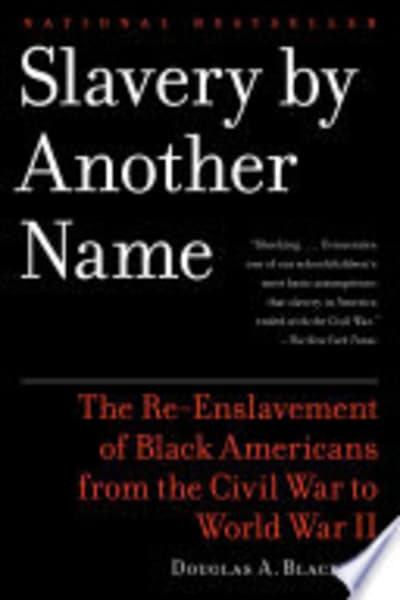
Slavery by Another Name — Book Summary & Review
Last updated:
Slavery by Another Name Summary
In Slavery by Another Name, Douglas A. Blackmon’s core framework is the “Age of Neoslavery,” a system he argues used post–Civil War law, fines, and coerced “debts” to convert Black freedom into involuntary labor. Blackmon lays out how local officials and state governments targeted African Americans through arrests designed to intimidate, then manufactured a rationale for selling prisoners to coal mines, lumber camps, brickyards, railroads, quarries, and farms. A particularly brutal concrete example is his discussion of how “debt” and court costs became a machine: people were seized, charged for the costs of their own punishment, and then leased out because there was no realistic path to pay. Blackmon also insists that this was not only prison-based; he describes how landowners seized workers directly and compelled long stretches of servitude outside any formal “sentence.”
What makes Blackmon’s argument stick is the way he tracks responsibility across levels—federal policy, state enforcement, local courts, and corporate demand—so the reader can see why prosecutions of white perpetrators were discouraged. He returns repeatedly to the theme that the system fed southern treasuries and helped keep racial terror politically useful, especially as African Americans sought full participation in elections and public life. He then follows the system’s decline into the 1940s, including the role of fears about enemy propaganda once World War II intensified scrutiny.
Honest limitation: Slavery by Another Name is heavy on documentation and institutional mechanics, so readers wanting a more intimate, character-driven narrative will feel the book’s pace slow when Blackmon is mapping legal pathways rather than lingering in personal scenes. Even so, Blackmon’s last pages leave you with the uncomfortable sense that the “new” slavery was only “new” in paperwork and enforcement, not in purpose.
Key Takeaways from Slavery by Another Name
-
1
Age of Neoslavery: a post-emancipation labor regime Blackmon ties to fines, courts, and leasing that replaced plantation slavery with paperwork.
-
2
Convict leasing: prisoners were sold to industry and farms because “debts” made payment impossible, turning sentences into labor contracts.
-
3
Arbitrary arrests and manufactured costs: Blackmon shows how officials charged people for the expenses of their own punishment to justify forced work.
-
4
Direct seizure by landowners: besides prisons, Blackmon documents how some workers were compelled into servitude without any legitimate sentencing story.
-
5
World War II propaganda pressure: Blackmon links the system’s weakening to fears of international exposure once the U.S. faced wartime scrutiny.
Who Should Read This
Someone who keeps bumping into vague claims like “slavery ended but exploitation continued” and wants the specific legal machinery behind it should read Slavery by Another Name. If you’ve ever wondered why civil-rights progress met such stubborn resistance, Blackmon’s account of courts, labor leasing, and racial terror will feel uncomfortably relevant.
Who Shouldn't Read This
If you’re looking for a smooth, purely narrative history with frequent character-centered scenes, you may find Blackmon’s documentary build slow and sometimes procedural. If you want a short, modern-policy argument with quick takeaways, this book’s scope—spanning law, labor, and institutions—will frustrate your desire for brevity.
Editor's Verdict
Blackmon’s best move is his insistence on the “Age of Neoslavery” as a legal-and-economic system, especially his explanation of how manufactured “debts” turned arrests into labor leasing. The real limitation is that the writing can feel more like careful institutional reconstruction than sustained personal storytelling, which may sap momentum for some readers. Anyone reading history while mid-career and feeling disillusioned by how slowly justice advances will hit hardest when Blackmon connects forced labor enforcement to political intimidation and delayed prosecution.
Ready to read Slavery by Another Name?
Get your copy on Amazon today.
Slavery by Another Name — Frequently Asked Questions
About Douglas A. Blackmon
Douglas A. Blackmon is an American journalist and author. He began his career as a reporter and has covered civil rights, labor, and the history of race in the United States. He is credible on slavery’s legacy because his investigative reporting traces how post–Civil War forced labor systems operated under legal and social cover. His notable works include Slavery by Another Name (2008) and the book-length follow-up, The Boundaries of Freedom (2013).