Six Easy Pieces — Book Summary & Review
Last updated:
Six Easy Pieces Summary
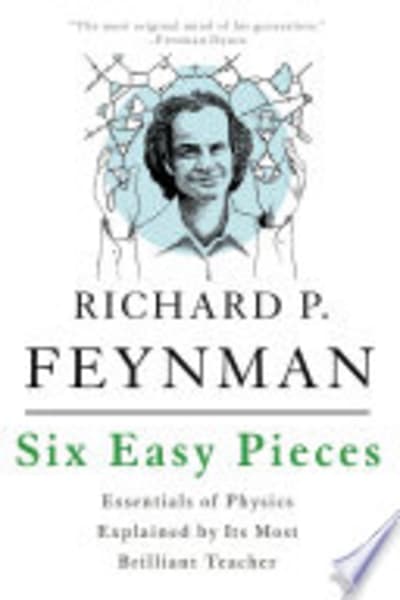
Feynman's 'Six Easy Pieces' kicks off by explaining atomic theory, introducing readers to the complex yet foundational concept of atoms and their interactions. The book is a distilled version of his celebrated lectures, known for their clarity and engaging style, covering topics like basic physics, energy conservation, and quantum mechanics. Feynman's conversational tone makes sections like 'The Relation of Physics to Other Sciences' particularly enjoyable, offering a cross-disciplinary perspective that deepens the reader's understanding of physics in the context of broader scientific inquiry. However, the book is not comprehensive and doesn't cover all aspects of physics in detail, focusing instead on a select few topics. This might leave readers seeking a more thorough exploration of physics feeling unsatisfied. Feynman's ability to make complex subjects accessible is unmatched, but those without any prior exposure to scientific concepts might find themselves struggling to grasp certain ideas despite his engaging explanations.
Key Takeaways from Six Easy Pieces
-
1
Atomic Hypothesis: Feynman explains how everything is made of atoms, offering a foundational understanding crucial for grasping further physics concepts.
-
2
Energy Conservation: This principle explains how energy cannot be created or destroyed, emphasizing its transformation across different states and forms.
-
3
Gravitational Principle: Feynman illustrates how gravity is not just a force but a curvature in spacetime, reshaping traditional views.
-
4
Quantum Behavior: Introduces the oddities of quantum mechanics, where particles exist in states of probability rather than defined paths.
-
5
Interdisciplinary Relation: Highlights how physics interacts with other sciences, demonstrating its central role in scientific advancements.
Who Should Read This
If you're someone wrestling with the basics of physics and want a clear, engaging introduction, this book is for you. Someone who appreciates learning through anecdotes and analogies will find Feynman's teaching style particularly beneficial.
Who Shouldn't Read This
If you're looking for an exhaustive textbook covering every aspect of physics, this isn't the book for you. Those seeking highly technical details or mathematical rigor will find the content too simplified.
Editor's Verdict
The best feature of 'Six Easy Pieces' is Feynman's ability to simplify complex topics, like his explanation of atoms in everyday language. However, the book lacks depth in covering the entirety of physics, focusing instead on selected topics. This book is perfect for anyone about to dive into their first physics course who wants a strong, engaging primer before tackling more technical materials.
Ready to read Six Easy Pieces?
Get your copy on Amazon today.
Six Easy Pieces — Frequently Asked Questions
About Richard Feynman
Richard Feynman was a renowned American theoretical physicist known for his work in quantum mechanics and particle physics. Born in 1918, he earned his Ph.D. from Princeton University. Feynman was awarded the Nobel Prize in Physics in 1965 for his contributions to the development of quantum electrodynamics. His credibility on the topic is underscored by his pioneering research and teaching. Other notable works include "The Feynman Lectures on Physics" and "Surely You're Joking, Mr. Feynman!"