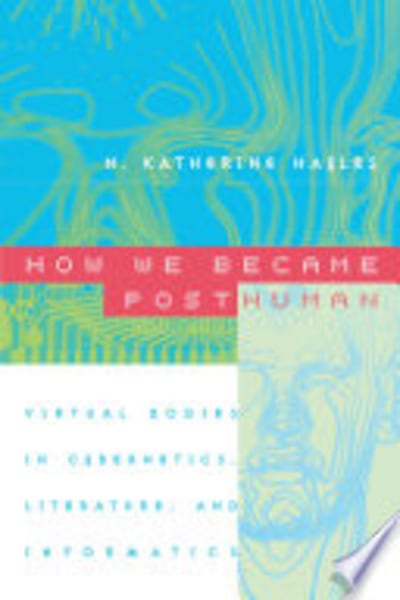
How We Became Posthuman — Book Summary & Review
Last updated:
How We Became Posthuman Summary
Hayles frames How We Became Posthuman around a three-part braid: how information got imagined as separable from the bodies that carry it, how “the cyborg” became a cultural machine, and how cybernetic discourse helped loosen the liberal humanist “subject.” The book’s spine is historiographic and argumentative, not thematic hand-waving: Hayles keeps returning to the same question—what had to be erased or bracketed so “information” could float free. One of her most concrete moves comes in the Macy Conferences material, where the cybernetics project tries to translate living systems into communication and control, quietly shifting what counts as real. She then pivots to literary case studies, including Bernard Wolfe’s 1952 novel Limbo, to show how the rhetoric of systems can make humans feel like malfunctioning components rather than embodied agents.
Hayles also leans hard on the cultural work of Philip K. Dick, treating hallucination and reality as more than plot devices; they become tests for what happens when the “self” is modeled as an information pattern. The concept of embodiment is the book’s constant pressure point: she argues that talk of “posthuman” futures often depends on forgetting that cognition, sensation, and agency are tied to material constraints. That’s why she spends real time on artificial life and on postmodern novels that recast humans as cybernetic systems—because the abstraction has consequences.
If you want a tidy defense of “liberation,” Hayles gives you both sides, but she doesn’t offer a practical roadmap for living in a world of AI and VR. And if you’re expecting a purely literary guide, her dense science-and-history scaffolding will feel like homework. Hayles doesn’t let you off the hook; she makes you see how posthuman talk is built.
Key Takeaways from How We Became Posthuman
-
1
Macy Conferences: Hayles uses early cybernetics meetings to show how living systems get reframed as communication and control problems.
-
2
Disembodied information: She argues “information” becomes thinkable only by separating it from bodies, labor, and material limits.
-
3
Cyborg construction: The cyborg is treated as a cultural model—technology plus ideology—rather than a neutral technological milestone.
-
4
Liberal humanist subject: Hayles shows cybernetic discourse dismantling the autonomous self into a system component with inputs and outputs.
-
5
Posthuman: The term names an epistemic shift—how we model agency—rather than a single future event or sci-fi gadget.
Who Should Read This
If you’re trying to make sense of AI, VR, and “consciousness uploading” talk that keeps ignoring the body, this will sharpen your skepticism. Someone who keeps bumping into claims that minds are software should read Hayles to understand what those claims require us to forget.
Who Shouldn't Read This
If you want a straightforward narrative with minimal theory, Hayles’s interwoven history of cybernetics and literary criticism will frustrate you. If you’re hoping for step-by-step guidance for building or using AI systems, this is more critique and genealogy than instruction.
Editor's Verdict
The best thing Hayles does is connect cybernetics’ technical abstractions to their cultural and literary aftershocks, especially through her treatment of the Macy Conferences and the argument about disembodied information. The limitation is that she rarely slows down to translate her theoretical moves into accessible, lived examples, so readers who need clarity-by-analogy may feel stranded. This hits hardest for graduate students and mid-career researchers who feel uneasy about how “systems thinking” quietly rewrites what counts as a person.
Ready to read How We Became Posthuman?
Get your copy on Amazon today.
How We Became Posthuman — Frequently Asked Questions
About N. Katherine Hayles
N. Katherine Hayles is an American literary scholar and professor of English and cognitive science. She earned her PhD in English from the University of California, Berkeley. Her research examines how media, information, and technology shape human identity and knowledge, making her credible for posthuman studies. She is the author of How We Became Posthuman (1999) and How We Think: Digital Media and Contemporary Technogenesis (2012).