The Renaissance — Book Summary & Review
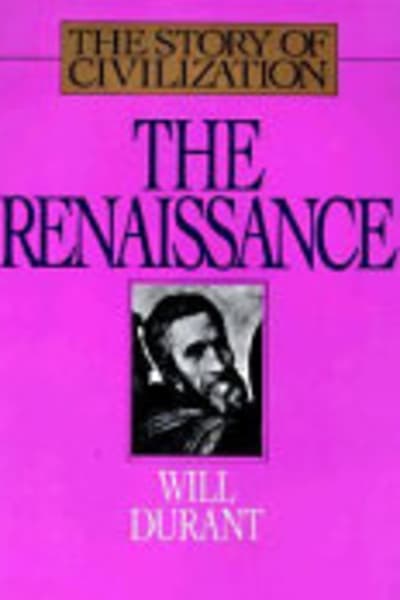
by Will Durant
Last updated:
The Renaissance Summary
In The Renaissance, Will Durant organizes his story around a recurring cast-and-cause framework: he repeatedly pairs artistic breakthroughs in Italy with the personal quirks, patronage ties, and practical constraints of the famous figures he follows. Durant’s emphasis is not “Renaissance” as a vague label; it’s Renaissance as a lived network—courts, guilds, workshops, libraries, and rivalries—where talent only becomes history when the right people fund, commission, copy, and argue. One of the book’s clearest structural moves is how Durant builds momentum by spotlighting specific personalities, then zooming out to show what their successes required from the surrounding society. He leans hard on familiar names, but he uses them as pegs to hang broader claims about learning, civic identity, and the slow retooling of European taste.
A concrete example: Durant’s attention to Florence’s environment makes artists look less like lone geniuses and more like skilled workers operating under real political weather. When he turns to Leonardo da Vinci, for instance, the point isn’t only that Leonardo was brilliant; it’s that his curiosity fits a wider culture that prizes observation, experimentation, and display. Durant also gives you a sense of how the printing and circulation of texts changes what educated people can actually access, which in turn shapes debates about religion, science, and authority.
The honest limitation: The Renaissance mostly stays in narrative history and famous biographies. If you want a dense science-first account—methods, experiments, lab results, or technical explanations of discoveries—Durant will frustrate you, because science here is largely social context and intellectual atmosphere rather than step-by-step practice. Still, if you like history where ideas ride on institutions and personalities, Durant’s method makes the era feel specific and workable.
Key Takeaways from The Renaissance
-
1
Renaissance as a network: Durant treats art and learning as products of patronage, workshops, and civic rivalries, not isolated genius.
-
2
Cast-and-cause framework: He pairs named figures with concrete social conditions to explain why achievements happen when they do.
-
3
Florence’s civic weather: The book shows how politics and competition shape commissions, careers, and public taste in specific Italian centers.
-
4
Text circulation’s pressure: Durant links the spread of books and ideas to changes in debate, education, and what people can cite.
-
5
Leonardo as cultural fit: His curiosity is used to represent a broader observational culture rather than only a personal biography.
Who Should Read This
Someone who’s stuck in the “great man” version of history and wants a more grounded explanation for why art and ideas actually get funded and spread. If you’re reading during a lull—after school, after a job change, or between hobbies—and you want an organized, character-driven history of the Italian Renaissance, Durant is likely to satisfy.
Who Shouldn't Read This
If you’re hunting for a technical science history with experiments, instruments, and methodological detail, Durant will feel too sociological and too biography-heavy. If you dislike older narrative histories that assume familiarity with major figures and rely on sweeping causal storytelling, this will likely feel padded rather than precise.
Editor's Verdict
The single best thing The Renaissance does is its cast-and-cause approach, using figures like Leonardo as entry points into the social machinery of Florence and the broader Italian world. The real limitation is that Durant treats science mainly as intellectual atmosphere and institutional context, not as a nuts-and-bolts record of scientific method or experiments. This hits hardest for anyone who’s mid-career and suddenly needs a reminder that knowledge advances through networks, incentives, and access, not just inspiration.
Ready to read The Renaissance?
Get your copy on Amazon today.
The Renaissance — Frequently Asked Questions
About Will Durant
Will Durant (1885–1981) was an American historian and writer, best known for his multi-volume history of Western civilization, The Story of Civilization. He studied philosophy and taught school before becoming a full-time author. Durant was credible on Renaissance history through his extensive research and synthesis of primary and secondary sources across European intellectual, cultural, and political developments. Other notable works include The Age of Faith and Caesar and Christ.