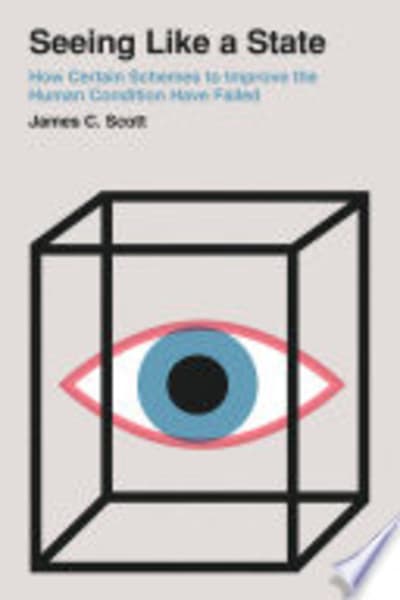
Seeing Like a State — Book Summary & Review
Last updated:
Seeing Like a State Summary
James C. Scott introduces 'legibility' as a framework to critique state-driven projects in 'Seeing Like a State'. The book argues that governments often simplify complex social systems to make them more manageable, leading to unintended consequences. In the chapter 'Authoritarian High Modernism', Scott dissects how grandiose plans like the Soviet collectivization and Brazilian urban projects fail due to their top-down nature. While the book is dense with historical examples, it does not offer solutions for how governments might better engage with local complexities. This might frustrate readers looking for actionable advice rather than a historical critique.
Key Takeaways from Seeing Like a State
-
1
Legibility: The state's attempt to simplify societies often leads to disastrous oversimplifications as seen in urban planning failures.
-
2
Authoritarian High Modernism: A belief in scientific and technical progress led to flawed projects like Soviet collectivization.
-
3
Metis: Local knowledge and skills, often overlooked by central planners, are crucial for successful social and economic policies.
-
4
Thin Simplifications: Oversimplified models like monoculture agriculture ignore ecological complexities, resulting in poor outcomes.
-
5
The Tragedy of Simplification: Centralized planning lacks adaptability, causing rigid systems unable to cope with local dynamics.
Who Should Read This
Someone who feels disillusioned with large-scale government projects and wants a historical perspective on why they often fail. If you're questioning the efficacy of big government interventions, this book provides a thorough critique.
Who Shouldn't Read This
If you're looking for practical solutions to government inefficiencies, you won't find them here. The book is dense with historical analysis but lacks prescriptive advice for modern policy-makers.
Editor's Verdict
Scott's analysis of 'Metis' highlights the importance of local knowledge in complex systems, making it a standout concept. However, the book's dense academic tone may alienate casual readers. Anyone frustrated with bureaucratic inefficiencies will find it enlightening, especially if grappling with similar issues in their professional life.
Ready to read Seeing Like a State?
Get your copy on Amazon today.
Seeing Like a State — Frequently Asked Questions
About James C. Scott
James C. Scott is a political scientist and anthropologist known for his work on state power and resistance. He is a Sterling Professor of Political Science at Yale University and has extensively studied peasant societies and agrarian studies. Scott's credibility on state dynamics is bolstered by his interdisciplinary approach and fieldwork. In addition to "Seeing Like a State," he authored "Weapons of the Weak" and "The Art of Not Being Governed," which explore similar themes of power and resistance.