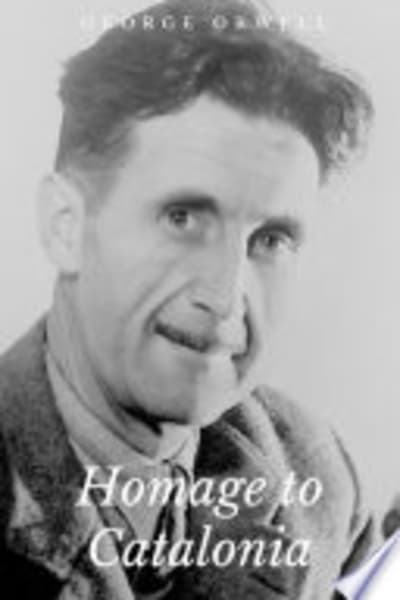
Homage to Catalonia — Book Summary & Review
Last updated:
Homage to Catalonia Summary
In Homage to Catalonia, Orwell anchors his account around a frontline framework of “POUM” solidarity and then shows how that promise curdles under Stalinist pressure. The book is structured like a lived report: Orwell joins the POUM militia in Catalonia, fights, gets wounded, and returns to England with an increasingly sharp sense that the war’s “enemy” is also being manufactured inside the movement. The most memorable concrete section is his depiction of the May Days aftermath in Barcelona, where street-level chaos and party discipline collide, and where the rhetoric of antifascist unity starts behaving like a purge machine.
Orwell’s argument isn’t delivered as a polished thesis; it’s built by repeated scenes: arrests, propaganda logic, interrogations, and the way Communist Party power reshapes what counts as truth. What lands is how Orwell contrasts his own comradeship with the bureaucratic cruelty of political policing—then follows the consequences all the way to the POUM being branded “Enemies of the People.” If you read Looking Back on the Spanish War alongside this, the pattern tightens: Orwell returns to the same events and explains the mechanisms he only glimpsed during the fighting.
A hard limitation: Homage to Catalonia doesn’t offer a broad, balanced survey of the Spanish Civil War. It’s intensely specific to Orwell’s side and his time in Catalonia, and readers hoping for a neutral political history or a full map of all factions will feel the ground drop out. Still, Orwell’s last pages leave you with a bitter clarity about how revolutions can be defeated by their own “allies,” and why Orwell’s skepticism, once formed, never relaxes.
Key Takeaways from Homage to Catalonia
-
1
POUM militia: Orwell’s firsthand view of how a worker-leftist force tries to fight Franco while staying politically independent.
-
2
May Days aftermath: Barcelona’s street conflict becomes a test case for whether antifascism means unity or factional domination.
-
3
“Enemies of the People”: a propaganda label Orwell shows being used to justify arrests, censorship, and the destruction of POUM networks.
-
4
Stalinist political policing: Orwell tracks how loyalty tests and controlled narratives replace battlefield reality.
-
5
Orwell’s injury and return: the shift from frontline immediacy to investigative hindsight sharpens his sense of who benefits from chaos.
Who Should Read This
Someone who’s trying to make sense of how left-wing movements fracture under external control will find Orwell’s Catalonia experience brutally relevant. If you’ve ever watched an idealistic cause turn into internal punishment, Orwell’s scenes from the POUM will land hard.
Who Shouldn't Read This
If you want a neutral, comprehensive history of the Spanish Civil War, Homage to Catalonia will feel lopsided and incomplete. If you prefer sleek, thematic nonfiction over messy personal chronology, Orwell’s eyewitness style may frustrate you.
Editor's Verdict
Homage to Catalonia’s best achievement is how Orwell turns the POUM’s street-level hopes into evidence for his claim that political power manufactures enemies, especially in the Barcelona turmoil. The real limitation is its narrow scope: it doesn’t function as a full war history, and it won’t satisfy readers seeking balanced faction-by-faction coverage. This hits hardest for readers who are mid-career and suddenly tired of ideological certainty, then want to see how certainty turns into coercion on the ground.
Ready to read Homage to Catalonia?
Get your copy on Amazon today.
Homage to Catalonia — Frequently Asked Questions
About George Orwell
George Orwell (1903–1950) was a British writer and journalist born in British India and raised in England. He served in the British Imperial Police in Burma and later worked as a soldier and reporter, experience that informed his political writing. He is credible on the Spanish Civil War because he personally traveled to Catalonia in 1936 as a participant-observer, documenting events in Homage to Catalonia. Other notable works include Animal Farm (1945) and Nineteen Eighty-Four (1949).