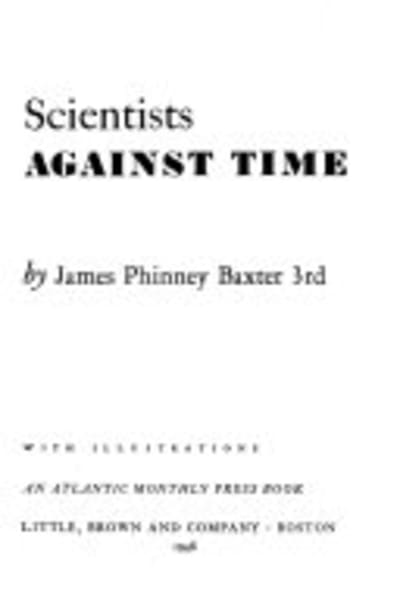
Scientists against Time — Book Summary & Review
Last updated:
Scientists against Time Summary
In Scientists against Time, James Phinney Baxter III organizes the story around the wartime medical-science machine at the U.S. Office of Scientific Research and Development (OSRD), and the whole book keeps circling one stubborn question: how do you speed up knowledge without letting it turn into sloppy myth? Baxter’s structure is part institutional history, part case study, and he repeatedly returns to specific OSRD routines for triage-by-evidence—who had authority, what kinds of data counted, and how research teams were pressured to produce usable results fast. One concrete example is his attention to the wartime logic of “field-ready” medicine: not just discovering cures, but packaging them into protocols that medics could actually apply under fire. Baxter also spends real time on the friction between laboratory time and military time, showing how scientists were recruited, managed, and sometimes constrained by bureaucratic deadlines. The book’s most persuasive through-line is that the OSRD didn’t simply “fund science”; it engineered a workflow where experimentation, documentation, and operational feedback were treated as a single system. Baxter’s account of medical research coordination, especially the way military medicine translated studies into practice, makes the OSRD feel like a living organism with incentives and failure modes.
Still, Baxter’s focus is narrow by design: he doesn’t offer a broad, modern guide to scientific productivity or a sweeping survey of all U.S. science policy, and readers hoping for vivid personal narratives from famous scientists will feel shortchanged. If you want lots of battlefield scenes or character-driven drama, Baxter’s tone will likely frustrate you. But if you’re curious how wartime institutions convert uncertainty into procedure, Baxter’s history earns its shelf space.
Key Takeaways from Scientists against Time
-
1
OSRD workflow: Baxter shows research funding as a managed pipeline, where evidence, reporting, and operational feedback were treated as one system.
-
2
Field-ready medicine: Experiments matter only when converted into protocols medics can use quickly under chaos and limited supplies.
-
3
Authority and evidence: Baxter tracks who gets to decide “good enough,” and how that power reshapes what gets studied and how.
-
4
Laboratory vs military time: The book contrasts long scientific cycles with urgent campaigns, then explains the compromises that followed.
-
5
Documentation pressure: Baxter emphasizes record-keeping and standardized communication as the real engine behind fast, transferable results.
Who Should Read This
Someone who is fascinated by how scientific research gets organized under extreme deadlines—like a project manager buried in approvals—will likely enjoy Baxter’s OSRD-centered account. If you’re currently wrestling with how to turn uncertain work into something operational without losing rigor, Baxter’s medical-science workflow will feel uncomfortably relevant.
Who Shouldn't Read This
If you’re looking for a narrative history driven by charismatic characters and dramatic set pieces, you may find Baxter’s institutional focus dry. If you want a modern, actionable guide to accelerating science in peacetime, Baxter doesn’t deliver that—his story stays anchored in the OSRD wartime context and its specific constraints.
Editor's Verdict
Baxter’s best move is using the OSRD as a lens to show how wartime medical research became “field-ready” through coordinated authority, documentation, and feedback loops. The limitation is that Baxter stays tightly on OSRD and wartime medical organization, so readers wanting a wider science-policy panorama or character-heavy storytelling will be disappointed. This hits hardest for anyone mid-career who’s watched projects stall, because Baxter’s account makes you see how incentives and workflow design decide whether knowledge ever reaches practice.
Ready to read Scientists against Time?
Get your copy on Amazon today.
Scientists against Time — Frequently Asked Questions
About James Phinney Baxter III
James Phinney Baxter III was an American author and journalist known for writing about science and technology. He served as a reporter and editor, and he wrote extensively on scientific and historical subjects, which makes him credible for explaining how scientific ideas and methods evolve over time. He is the author of Scientists Against Time. He also wrote other works on science and history, including The Discovery of the Past and The World’s Most Famous Experiments.