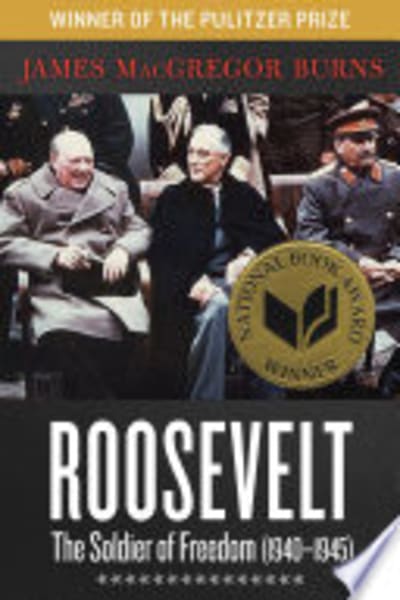
Roosevelt: The Soldier of Freedom — Book Summary & Review
Last updated:
Roosevelt: The Soldier of Freedom Summary
Burns structures Roosevelt: The Soldier of Freedom around FDR’s wartime presidency as both a command performance and a political project—especially the decisions that flow from the 1940 third-term election and the shift toward an explicit post-war peace vision. Burns doesn’t treat Roosevelt as a lone genius; he treats him as a strategist who reads rooms, bargains with institutions, and uses crises to align public will with policy. A concrete highlight is the way Burns tracks Roosevelt’s management of the wartime alliance problem—how “the soldier of freedom” framing sits beside the less poetic realities of coalition politics, military priorities, and the constant negotiation between what the public will tolerate and what commanders need. Burns also leans hard into Roosevelt’s rhetorical and legislative choreography, showing how the president’s political talent becomes a tool for sustaining sacrifice without collapsing support.
In the second half, Burns broadens from wartime leadership to the question that hovers over everything: what happens after victory. The book’s post-war sections feel like their own argument inside the larger biography, with Burns emphasizing Roosevelt’s desire to shape the peace rather than merely survive the war. If you’ve ever wondered how a leader can plan for tomorrow while fighting for today, Burns gives you that tension in explicit form—Roosevelt’s goals keep colliding with Congress, allies, and the stubborn inertia of bureaucracy.
Limitation: Burns writes with a biographer’s patience and political-literary density, so readers who want a fast, narrative-only war history will find the constant institutional analysis tiring, and the focus stays tightly on FDR rather than offering equal time to generals, rank-and-file soldiers, or ordinary civilians.
Key Takeaways from Roosevelt: The Soldier of Freedom
-
1
Third-term election logic: Burns treats 1940 as the hinge that turns wartime leadership into a long political campaign.
-
2
Wartime alliance management: Roosevelt’s strategy is shown as coalition maintenance—public messaging, bargaining, and military reality checks.
-
3
Post-war peace planning: Burns argues Roosevelt sought to design victory’s aftermath, not simply end the fighting.
-
4
Political talent as machinery: FDR’s gifts are framed as practical tools—sequencing, coalition-building, and legislative momentum.
-
5
Biographical density: Burns foregrounds institutions and personalities, so you read for argument as much as for events.
Who Should Read This
If you’re trying to understand how Franklin Roosevelt kept American support steady while the war escalated and politics refused to cooperate, this will give you a usable framework. Someone who likes biography that treats elections, Congress, and diplomacy as the real battlegrounds will likely feel at home here.
Who Shouldn't Read This
If you want a straightforward operational history of World War II with minimal political theory, Burns will feel overstuffed and slow. If you’re impatient with long institutional explanations and prefer chapters that center military action above all else, you’ll get frustrated quickly.
Editor's Verdict
Burns’ best work is how he connects Roosevelt’s 1940 third-term pivot to wartime decision-making and then carries that through to the post-war peace agenda, treating leadership as a continuous political project. The limitation is that the book stays overwhelmingly FDR-centered and institution-heavy, so readers seeking balanced attention to soldiers, civilians, or battlefield mechanics will feel shortchanged. This lands hardest for anyone who’s mid-career and suddenly realizes “leadership” is mostly bargaining under constraints—especially if you’re reading to make sense of modern crisis governance.
Ready to read Roosevelt: The Soldier of Freedom?
Get your copy on Amazon today.
Roosevelt: The Soldier of Freedom — Frequently Asked Questions
About James MacGregor Burns
James MacGregor Burns (1918–2014) was an American political historian and biographer. He earned a PhD from Harvard University and taught at institutions including Princeton and the University of Maryland. Burns is credible on Franklin D. Roosevelt because he produced major, extensively researched studies of Roosevelt’s leadership and political life. His notable works include Roosevelt: The Lion and the Fox (1956) and Roosevelt: The Soldier of Freedom (1970), plus Leadership (1978).