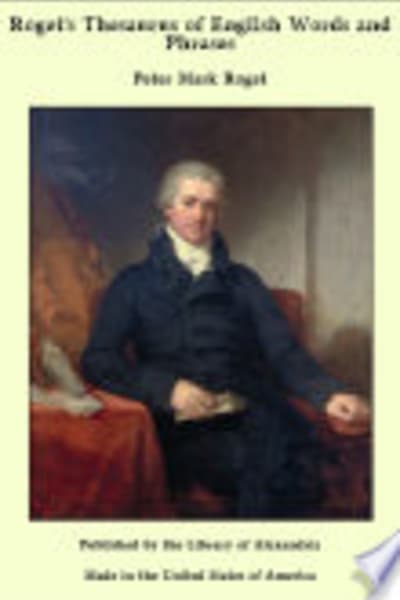
Roget's Thesaurus — Book Summary & Review
Last updated:
Public domain via Project Gutenberg — free and legal.
Roget's Thesaurus Summary
Roget’s Thesaurus is organized around Roget’s central idea of grouping words by “ideas,” then routing you through a dense lattice of categories, subcategories, and cross-references rather than an alphabetical list. The book’s core engine is the system Roget designed: you start with a concept, then move through semantically related terms, with antonyms and near-neighbors offered by the structure itself. One of the most useful concrete features is the “Classifications” portion, where broad headings subdivide into more specific notions; it’s the closest thing to a map you’ll get in a reference work this large. I kept returning to the way the entries force you to think in relationships—how a word’s meaning shifts when you pull it from one idea cluster into another.
The 1975 revision matters because it updates the vocabulary and keeps the cross-linking practical for modern English usage, so you’re not stuck with a historical museum of terms. Roget’s Thesaurus also gives you more than synonyms: it’s engineered to help you choose diction by nudging you toward the right register and shade of meaning. If you’re drafting and your sentence feels bland, you can hunt by the idea behind the blandness, then test candidates in context.
Honest limitation: this is not a narrative book and it doesn’t teach writing strategy. If you want explanations, examples in full sentences, or guidance on how to build better prose, you’ll be frustrated—this is reference architecture, not coaching. And if you need quick lookup by spelling, the conceptual organization will slow you down.
Key Takeaways from Roget's Thesaurus
-
1
Idea-based organization: Roget’s system groups words by concept first, making synonym hunting feel like navigation rather than searching.
-
2
Classifications structure: broad headings subdivide into finer notions, letting you narrow from “emotion” to usable diction without guessing.
-
3
Cross-references logic: entries point you across related categories, so you can pivot when one synonym doesn’t fit your meaning.
-
4
Antonym proximity: the layout intentionally brings opposites into your field of view, helping you refine contrast in writing.
-
5
1975 revision scope: the update keeps the network usable for modern English, avoiding a purely historical vocabulary trap.
Who Should Read This
If you’re drafting something right now and your vocabulary feels stuck—same verbs, same adjectives, same rhythm—Roget’s Thesaurus gives you a concept-first way out. Someone who keeps rewriting sentences but can’t name what’s missing will benefit from hunting by idea clusters instead of word-by-word tinkering.
Who Shouldn't Read This
If you want a book that teaches writing through examples and explanations, you’ll be disappointed by how purely structural Roget’s Thesaurus is. If you only need fast spelling-based lookup or you hate large reference formats, the conceptual navigation will feel like work rather than help.
Editor's Verdict
Roget’s Thesaurus earns its keep by making idea-to-word retrieval genuinely systematic, especially in the “Classifications” portion where categories subdivide into usable meaning zones. The limitation is straightforward: it offers no instruction, no prose examples, and no writing strategy—just an enormous organizational map. Anyone preparing a speech, cover letter, or essay mid-draft will hit the best payoff when they realize they don’t need “more words,” they need the right idea cluster for the sentence they’re trying to fix.
Ready to read Roget's Thesaurus?
Get your copy on Amazon today.
Roget's Thesaurus — Frequently Asked Questions
About Peter Mark Roget
Peter Mark Roget (1779–1869) was a British physician and naturalist. He served as a physician and was trained in systematic observation, which supported his interest in organizing knowledge. Roget compiled Roget’s Thesaurus to group words by ideas, drawing on his methodical approach to classification and language. He is credible on this topic because his medical and scientific work emphasized structured taxonomy. Other notable works include Animal and Vegetable Physiology (1817) and Bridgewater Treatise on the Physiology of Man (1834).