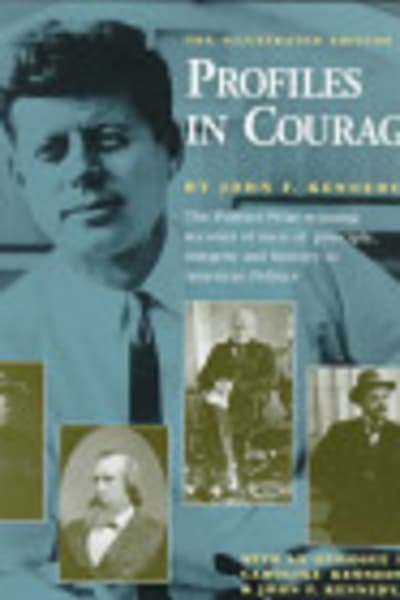
Profiles in Courage — Book Summary & Review
Last updated:
Profiles in Courage Summary
Profiles in Courage is built around Kennedy’s decision to frame political ethics through eight named senators and statesmen, each treated as a case study in what he calls integrity under pressure. The book’s method is simple but disciplined: Kennedy doesn’t argue for courage in the abstract; he picks a moment where a public figure is tempted to compromise, then narrates the cost of refusing. One of the clearest through-lines is how Kennedy uses John Quincy Adams’ stubborn opposition to popular sentiment—Adams arguing against slavery’s expansion while paying for it in influence and comfort. Kennedy then widens the lens with Daniel Webster, stressing that “courage” can look like restraint and principle rather than theatrical defiance, and he connects that to how legislators earn trust over time. Thomas Hart Benton gets a harsher treatment: Kennedy shows courage as endurance in an era when being right doesn’t protect you from being punished, especially when your enemies control the narrative and the machinery of power. The book’s most politically intimate portrait for me is Robert A. Taft, because Kennedy circles the idea that responsibility is a kind of courage too—the refusal to let party convenience decide your vote. In Kennedy’s hands, courage becomes less about martyrdom and more about staying answerable to conscience and public duty even when the math turns ugly.
A limitation you should know up front: Profiles in Courage is selective and moralizing, not exhaustive. Kennedy doesn’t try to explain every historical context in depth, and he’s less interested in debunking myths than in reinforcing an ethical tradition. If you want rigorous historiography or a balanced debate between competing interpretations, Kennedy will frustrate you; this is a political portrait gallery organized to persuade, not a neutral archive.
Key Takeaways from Profiles in Courage
-
1
Profiles in Courage treats political ethics as case studies, using eight specific lawmakers to show integrity has costs.
-
2
John Quincy Adams is presented as courage under social pressure, where unpopular moral stands reduce influence and comfort.
-
3
Daniel Webster’s courage is framed as disciplined restraint, not spectacle, tied to long-term trust in legislation.
-
4
Thomas Hart Benton illustrates endurance, showing that being right can still mean losing power when opponents control narratives.
-
5
Robert A. Taft turns responsibility into courage, arguing conscience must survive party incentives and electoral math.
Who Should Read This
Someone who feels their job rewards safe choices over principled ones will find Kennedy’s portraits uncomfortably clarifying, especially when you’re deciding whether to speak up at work. If you’re in a leadership role and keep asking what “integrity” means in practice, this book gives you concrete historical models to borrow from.
Who Shouldn't Read This
If you want modern, research-heavy biography with footnoted nuance and competing viewpoints, Kennedy’s persuasive structure will feel thin and one-directional. If you dislike moral lectures disguised as history, you’ll probably resent how often Profiles in Courage turns events into an explicit lesson.
Editor's Verdict
The best thing Profiles in Courage does is show courage as a legislative behavior, not a personality trait—Kennedy’s Taft chapter makes responsibility feel like something you can fail in, not just admire. The limitation is that Kennedy’s selectivity and moral framing leave out the deeper historical disagreement a skeptical reader will crave. This hits hardest for anyone mid-career questioning why they keep compromising, because Kennedy’s examples make the “cost of silence” concrete on the page.
Ready to read Profiles in Courage?
Get your copy on Amazon today.
Profiles in Courage — Frequently Asked Questions
About John F. Kennedy
John F. Kennedy (1917–1963) was an American politician and the 35th president of the United States. Before his presidency, he served in the U.S. Navy during World War II and represented Massachusetts in the U.S. House of Representatives and the U.S. Senate. He was credible on political courage because his career involved high-stakes public service and bipartisan legislative action. He wrote Profiles in Courage (1956), which won the Pulitzer Prize, and also authored Why England Slept (1940).