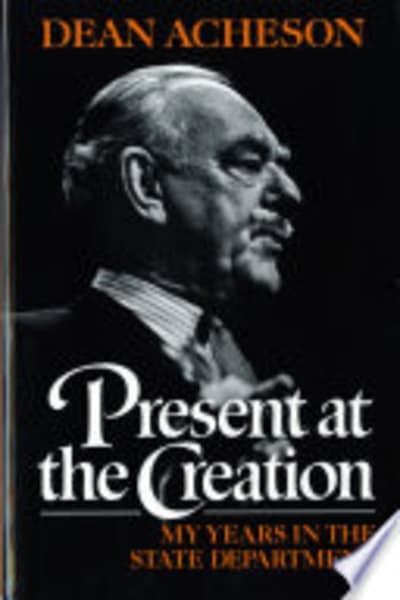
Present at the Creation — Book Summary & Review
by Dean Acheson
Last updated:
Present at the Creation Summary
Dean Acheson structures Present at the Creation around the State Department’s internal logic—how decisions get shaped by personalities, memos, and institutional constraints—while he simultaneously narrates his own rise and the policy choices that defined the early Cold War. The book’s first half reads like autobiography with a job description: Acheson’s voice keeps returning to process, especially the slow grind from briefing room to cabinet table. A standout stretch is the account of the Truman administration’s formation of containment, where Acheson shows how “inevitabilities” were manufactured through meetings, drafts, and tradeoffs rather than discovered after the fact. He also leans hard on the way officials learn to speak in probabilities, not certainties, and he makes that habit feel like a discipline you can see in the documents.
One chapter sequence that sticks with me is the discussion of the Marshall Plan and the diplomatic choreography around European recovery; Acheson treats economic aid as a political instrument with a timeline, not a moral gesture. Later, his treatment of the Korean War crisis is especially revealing—not because it’s a blow-by-blow thriller, but because he’s honest about the gap between what leaders fear, what they can verify, and what they’re willing to authorize. He returns again and again to the theme that diplomacy is built from leverage, credibility, and timing, and he uses his own scars to demonstrate how credibility is earned and then spent.
Limitation: this is not a neutral survey history for casual readers; it’s a statesman’s memoir-first argument. If you want a balanced, multi-archival account of every major policy dispute, Acheson’s perspective will feel one-sided and sometimes self-justifying.
Key Takeaways from Present at the Creation
-
1
Containment as practice: Acheson frames containment less as a slogan and more as a chain of policy decisions under uncertainty.
-
2
Cabinet-room memo logic: He shows how wording, timing, and internal persuasion inside the Truman White House drive outcomes.
-
3
Marshall Plan choreography: Economic aid appears as scheduled leverage—designed to stabilize governments and reduce strategic risk.
-
4
Korean War decision pressure: Acheson emphasizes verification limits, fear management, and authorization thresholds during fast-moving crises.
-
5
State Department institutional memory: Acheson treats bureaucracy as a knowledge system that can both correct and distort leaders.
Who Should Read This
Someone who’s staring at a career crossroads—policy, law, business strategy, or public service—and needs to understand how real decisions get made under political pressure should read Acheson. If you’ve ever wondered why “good intentions” fail once meetings, memos, and timelines enter the picture, Present at the Creation will feel uncomfortably relevant.
Who Shouldn't Read This
If you want a lightweight, narrative history with minimal institutional detail, you’ll find Acheson’s memoir-heavy structure and dense governmental texture exhausting. If you’re looking for a fully balanced account that foregrounds critics as much as Acheson, you may feel the book is too self-defending and too narrow in viewpoint.
Editor's Verdict
The best thing Present at the Creation does is make diplomacy feel like a working system, especially in Acheson’s treatment of the Marshall Plan as scheduled leverage rather than a vague act of generosity. The real limitation is that it’s Acheson’s perspective first, with insufficient willingness to fully litigate opposing internal views or later historiographic debates. This book hits hardest for anyone early in a policy career who’s about to learn that “strategy” is mostly paperwork, persuasion, and timing—before your first major briefing.
Ready to read Present at the Creation?
Get your copy on Amazon today.
Present at the Creation — Frequently Asked Questions
About Dean Acheson
Dean Acheson (1893–1971) was an American lawyer and diplomat who served as U.S. Secretary of State (1949–1953). He helped shape U.S. foreign policy during and after World War II, including the Marshall Plan and early Cold War strategy. His firsthand experience in high-level decision-making makes him credible on the origins and early conduct of the postwar international order. Other notable works include Present at the Creation (1969) and Power and Diplomacy (1958).