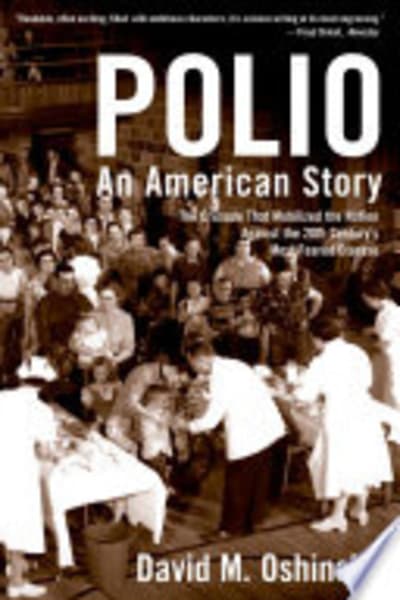
Polio: An American Story — Book Summary & Review
Last updated:
Polio: An American Story Summary
In Polio: An American Story, David Oshinsky anchors the narrative in the March of Dimes fundraising machine and then uses that civic engine to explain how polio panic reshaped American science, law, and daily life. The book’s structure keeps snapping between lab work and public spectacle: early chapters track how the National Foundation for Infantile Paralysis turned fear into money and attention, while later sections zoom in on the Salk–Sabin rivalry, including the way personal temperament and institutional strategy collided in the race for vaccines. Oshinsky’s most vivid framework is the contrast between what the media implied and what the epidemiology actually showed—polio was frightening, but it was not the constant raging catastrophe newspapers implied. He returns to that tension repeatedly, so the reader feels how a relatively uncommon disease could still dominate suburban routines, school policies, and family anxieties in the early 1950s.
One reason Oshinsky keeps earning his suspense-story label is his use of newly available materials around Jonas Salk and Albert Sabin, plus the overlooked figure of Isabel Morgan, who Oshinsky argues had real chances to get there first if she hadn’t stepped back to raise a family. The book’s “beyond” portion also matters: it follows how the polio era changed drug licensing and liability, so the story lands not only in the vaccine moment but in lasting regulatory habits. Oshinsky is at his best when he ties scientific uncertainty to political pressure—when headlines, donors, and government oversight all tug the same researchers in different directions.
Limitation: Oshinsky is writing history with a sociological spine, so if you want a purely technical account of virology experiments or a tight, chronological blow-by-blow of every trial, you’ll feel the emphasis drift toward institutions and culture rather than bench-level detail.
Key Takeaways from Polio: An American Story
-
1
National Foundation for Infantile Paralysis: Oshinsky shows how the March of Dimes transformed fear into research funding at national scale.
-
2
Salk–Sabin rivalry: The vaccine race is portrayed as personal and institutional conflict, not a clean, heroic contest.
-
3
Isabel Morgan: Oshinsky highlights a major contributor whose career choices altered who got credited for breakthroughs.
-
4
Poster children: Fundraising relied on specific human stories, turning medical need into public persuasion.
-
5
Regulatory and liability shifts: Polio-era pressure reshaped how the government licenses drugs and how courts handle manufacturer risk.
Who Should Read This
Someone who lived through the aftershocks of modern health scares—lockdowns, vaccine debates, or media-driven panic—will recognize the civic machinery Oshinsky describes. If you’re curious how fundraising, government policy, and personal rivalry can steer scientific outcomes, Oshinsky’s Polio will feel uncomfortably relevant.
Who Shouldn't Read This
If you want a strictly chronological, experiment-by-experiment account of vaccine development, Oshinsky’s focus on institutions and culture will frustrate you. If you dislike history that argues from media narratives and public policy, you may find the book’s central comparisons too persistent.
Editor's Verdict
Polio’s best strength is how Oshinsky uses the March of Dimes and the National Foundation for Infantile Paralysis to connect fundraising, regulation, and the Salk–Sabin race into one coherent engine. The limitation is that Oshinsky keeps returning to cultural and institutional interpretation, so readers seeking deep technical virology will feel underfed. This book hits hardest for anyone who remembers how quickly public fear can become policy pressure—especially if you’re now rethinking what “vaccine success” means beyond the lab.
Ready to read Polio: An American Story?
Get your copy on Amazon today.
Polio: An American Story — Frequently Asked Questions
About David Oshinsky
David M. Oshinsky is an American historian and author. He has written extensively about U.S. public health and the history of medicine, including the polio era. He is credible on this topic through his scholarly research and focus on American health policy and institutions. His notable works include Polio: An American Story (2005) and A Conspiracy So Immense: The World of the American Spy (1983).