Original Meanings — Book Summary & Review
Last updated:
Original Meanings Summary
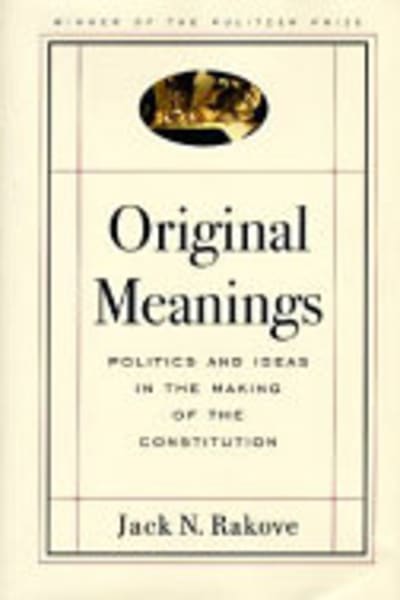
In Original Meanings, Jack N. Rakove builds a careful framework for reading the Constitution by treating “original meaning” as a historical argument you can test against framing and ratification records, not as a slogan. The book’s spine is Rakove’s insistence that we should track how specific actors—especially James Madison—understood the Constitution while it was still being argued into existence. He doesn’t pretend the framers spoke with one voice; instead, he maps competing comprehension strategies: what counts as evidence, who gets to claim authority, and why ratification-era context matters.
A concrete highlight is the way Rakove uses Madison to show how “meaning” can be mediated through political experience and institutional stakes. When Rakove moves through the framing and ratification debates, he keeps returning to the problem that modern originalism often flattens: different participants used different interpretive tools, and those tools were shaped by immediate constitutional controversies. Even when you disagree with Rakove’s conclusions, his method is sturdy—he treats legal interpretation as something historians can reconstruct, then he presses the reader to see where reconstruction runs out.
Rakove also spends time on the political dimension of constitutional interpretation: arguments about liberty, power, and legitimacy weren’t academic exercises. That historical messiness is the point, and Rakove makes it hard to keep “original meaning” clean and tidy.
Limitation: this is not a quick primer for practicing lawyers or a systematic defense of any modern interpretive doctrine; it’s a historian’s reconstruction aimed at debates, so readers wanting a step-by-step “how to decide cases” guide will feel stalled. If you want citations-heavy, argument-mapping history that may frustrate you with its refusal to simplify, Rakove will likely be your kind of aggravating.
Key Takeaways from Original Meanings
-
1
Original meaning: Rakove treats it as a testable historical claim anchored in framing and ratification evidence.
-
2
Madison’s role: he uses Madison as a lens on how political experience shaped constitutional comprehension.
-
3
Framing and ratification debates: Rakove argues these moments produce different kinds of evidence, not one unified story.
-
4
Interpretive authority: the book scrutinizes who gets to define meaning and what qualifies as legitimate historical proof.
-
5
Political stakes: constitutional interpretation, for Rakove, is inseparable from legitimacy struggles and power contests.
Who Should Read This
Someone who keeps hearing “original meaning” invoked in debates and wants to understand what the phrase actually has to prove. If you’re staring at constitutional history coursework or a legal-history reading list and need a historian’s method, Rakove is a strong bet.
Who Shouldn't Read This
If you want a user-friendly, modern-originalism playbook with direct case applications, Rakove will frustrate you. If you dislike dense argumentation and long historical evidentiary discussions, this book’s pace will feel punishing.
Editor's Verdict
The best thing Original Meanings does is show how Rakove’s Madison-centered reconstruction forces you to distinguish evidence from slogans while tracking comprehension during framing and ratification. The real limitation is that it offers little in the way of practical interpretive instructions for modern constitutional litigation. Anyone preparing for a constitutional history exam or writing a seminar paper will hit hardest when they need to argue about what “meaning” can responsibly mean.
Ready to read Original Meanings?
Get your copy on Amazon today.
Original Meanings — Frequently Asked Questions
About Jack N. Rakove
Jack N. Rakove is an American historian and professor of history and political science at Stanford University. He specializes in the origins of the U.S. Constitution and early American political thought. Rakove is credible on this subject because his scholarship focuses on primary sources from the founding era and he has published extensively on constitutional interpretation and the Founders’ political debates. He is the author of Original Meanings (1996) and The Beginnings of National Politics (1979).