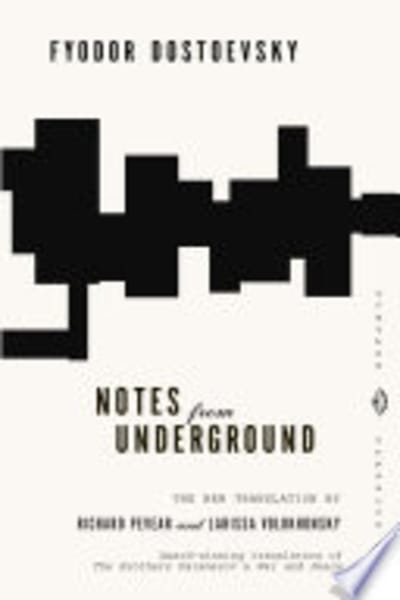
Notes from the Underground — Book Summary & Review
Last updated:
Public domain via Project Gutenberg — free and legal.
Notes from the Underground Summary
In Notes from the Underground, Dostoyevsky frames the whole performance as an argument against utopian social planning—then has the narrator sabotage his own logic in real time, as if to prove the point. The unnamed speaker is a disgraced former official who retreats into a self-made bunker and writes because silence would be worse than contradiction. Pevear and Volokhonsky’s translation matters here: the voice stays sharp, slippery, and oddly funny, especially when the narrator goes from grand theory to petty spite within the same breath. The book’s structure is simple—one sustained confession—but it feels like multiple essays welded together: a philosophical rant, a social critique, and a psychological autopsy. Dostoyevsky’s key move is to treat “rational self-interest” like a slogan that collapses under lived emotion. He attacks the idea that people can be engineered into happiness, not by offering a friendly alternative, but by showing how humans will choose discomfort just to defend the right to refuse. A concrete example: in the narrator’s discussion of the “crystal palace,” he mocks the promise of a perfectly managed future and insists that even if comfort were guaranteed, the human will still rebel, partly from pride, partly from irrationality. Another concrete example is the narrator’s obsession with the “two times two” mentality—how he keeps returning to the fantasy that life could be reduced to arithmetic, then demonstrates how that fantasy turns cruel and sterile. Dostoyevsky is not trying to comfort you; he’s trying to make you sit with the uglier parts of thinking. Honest limitation: this book won’t satisfy readers who want plot momentum or a clean resolution, because the payoff is rhetorical and psychological, not narrative.
Enjoyed this one? Read these next.
Top picks in Short Stories, chosen for readers of Notes from the Underground.

Collected Stories
by Katherine Anne Porter
Check price on Amazon
The Collected Stories
by Jean Stafford
Check price on Amazon
The Stories of John Cheever
by John Cheever
Check price on Amazon
Interpreter of Maladies
by Jhumpa Lahiri
Check price on AmazonKey Takeaways from Notes from the Underground
-
1
Underground Man: A narrator who uses confession as a weapon, turning self-knowledge into a way to stall change.
-
2
Crystal Palace: The utopian future of guaranteed comfort, rejected because human refusal and pride won’t be scheduled away.
-
3
Two times two: The arithmetic fantasy that reason can settle moral life, mocked through the narrator’s behavior and contradictions.
-
4
Irrational nature: Dostoyevsky insists people act from spite, vanity, and emotional momentum, even when logic predicts otherwise.
-
5
Self-contradictory narration: The book’s form is the argument; Dostoyevsky makes inconsistency feel like lived truth.
Who Should Read This
Someone who is stuck in a loop of self-criticism and secret resentment will recognize the Underground Man’s logic as familiar, not abstract. If you’ve been arguing with “common sense” plans for your life and still feel the urge to sabotage them, Dostoyevsky will hit hard.
Who Shouldn't Read This
If you need a storyline with forward motion and a satisfying ending, this retreating, talky confession will frustrate you. If you want a tidy political alternative to utopianism, Dostoyevsky refuses to provide one and leaves you wrestling with discomfort instead.
Editor's Verdict
The single best thing Notes from the Underground does is stage Dostoyevsky’s critique of social utopianism through the narrator’s self-undermining voice, especially in the crystal palace argument. The limitation is that the book offers mostly rhetoric and psychological self-portraiture, with little narrative propulsion or external action. This hits hardest for anyone who’s mid-crisis and trying to “solve themselves” with logic—right after you’ve made a plan and then immediately felt the urge to break it.
Ready to read Notes from the Underground?
Get your copy on Amazon today.
Notes from the Underground — Frequently Asked Questions
About Fyodor Dostoyevsky
Fyodor Dostoyevsky (1821–1881) was a Russian novelist and essayist from Moscow, raised in a literary and religious household and later imprisoned in Siberia for political activity. He is credible to write about alienation and inner conflict because his works draw on firsthand experience with state repression, moral crisis, and psychological torment, especially after his exile. Notable works include Crime and Punishment and The Brothers Karamazov.