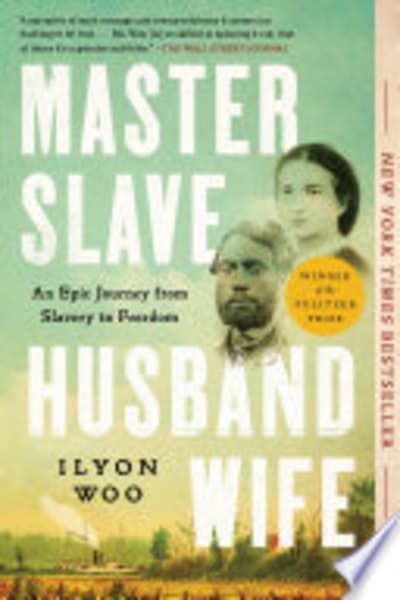
Master Slave Husband Wife — Book Summary & Review
by Ilyon Woo
Last updated:
Master Slave Husband Wife Summary
In Master Slave Husband Wife, Ilyon Woo builds the book around two linked performances of identity—Ellen’s public “passing” as a disabled white man and William’s role as “his” enslaved servant—then tracks how those performances collide with the Fugitive Slave Law of 1850. Woo opens with the December 1848 escape from Macon, Georgia, but the real engine is how Ellen and William move through ordinary spaces as if they belong there: railcars, coaches, and steamships, with abolitionist listeners who first hear their story and then test it against the nation’s slogans. Ellen’s disguise is not a gimmick; Woo treats it like a daily, high-wire negotiation of language, clothing, posture, and risk, and she keeps returning to the ugly logic that the law would rather call them fraud than acknowledge the humanity it threatens. Woo then pivots to the lecture circuit, where the couple’s survival becomes public argument—William’s presence and Ellen’s careful control of what can be said turn stage time into legal pressure. The book’s most memorable section is the lead-up to the 1850 crackdown: Woo shows how quickly “free” geography turns conditional when statutes, informants, and federal enforcement line up. When Woo reaches the moment they flee the United States, the point lands with particular force: their existence exposes the contradiction at the heart of “life, liberty, and justice for all,” because the country requires people like Ellen and William to hide in order to live. Woo’s limitation is that she can’t fully reconstruct every private thought of Ellen and William; she relies on historical record and braided narrative focus, so readers craving deep psychological interiority may feel the edges of the evidence. Still, for a short 209 pages, Woo gives you a tight, documentary-feeling argument about how survival can function as protest—and how law can turn protest into a chase.
Key Takeaways from Master Slave Husband Wife
-
1
Ellen’s “passing” frames survival as performance, where clothing, speech, and stance manage risk in public spaces.
-
2
William as “his” slave shows how roles get weaponized, then repurposed, to exploit the era’s expectations.
-
3
Abolitionist lecture circuit turns lived escape into testimony, forcing audiences to confront what their politics won’t protect.
-
4
Fugitive Slave Law of 1850 converts geography into danger, making “north” contingent on enforcement networks.
-
5
Woo’s historical braid links disguise, movement, and law, so each chapter changes the stakes of the last.
Who Should Read This
Someone who keeps running into the same historical question—why freedom depended on paperwork and appearance—should read Woo’s account of Ellen and William’s escape. If you’re trying to understand how activism and legal systems collide in real time, Master Slave Husband Wife gives you a concrete, frightening timeline.
Who Shouldn't Read This
If you want a slow-burn, character-first novelistic voice with lots of inner monologue, Woo’s reliance on what records can support will frustrate you. If you’re looking for a broad survey of slavery across regions, this book’s focus on one couple’s movement and legal pressure will feel narrow.
Editor's Verdict
The single best thing Woo does is make the lecture circuit feel like strategy, not spectacle, especially in the run-up to the Fugitive Slave Law of 1850. The real limitation is that Woo doesn’t attempt deep psychological interiority; she stays tethered to evidence and public events, which can leave emotional gaps. This will hit hardest if you’re a history reader who’s tired of abstract debates and wants to see law, disguise, and enforcement collide in specific moments.
Ready to read Master Slave Husband Wife?
Get your copy on Amazon today.
Master Slave Husband Wife — Frequently Asked Questions
About Ilyon Woo
Ilyon Woo is an American journalist and author. He has reported on history, politics, and social issues for major publications and is known for rigorous research and primary-source documentation. He is credible on slavery-era topics through his investigative, archival approach to writing about the lives of enslaved people and the institutions that shaped them. His notable works include Master Slave Husband Wife (2010) and The Great Fire of 1906 (2017).