Master of the Senate — Book Summary & Review
by Robert Caro
Last updated:
Master of the Senate Summary
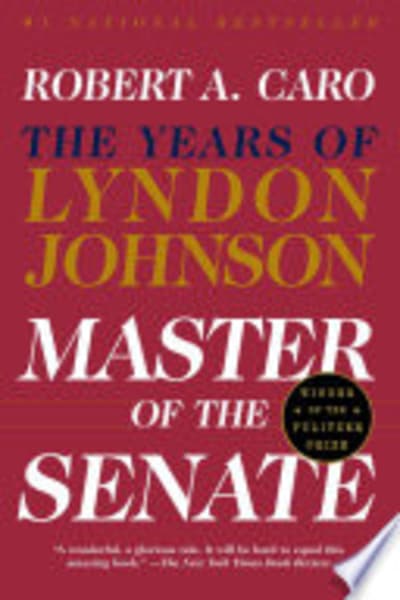
In Master of the Senate, Robert Caro builds his argument around a slow, forensic dismantling of the Senate’s “rules and customs” until you can see exactly how Lyndon Johnson weaponizes them. Caro frames the book by contrasting the Senate’s earlier era of Daniel Webster, Henry Clay, and John C. Calhoun—where the institution was the gravitational center of national decision—with the mid-century Senate that mostly reacts to executive initiatives. The real engine of the narrative is Caro’s insistence that Johnson’s rise is not personality alone; it’s a practiced method of turning procedure, seniority, and personal leverage into legislative outcomes.
One of the most concrete examples is Caro’s account of how Johnson becomes Majority Leader after only a single term, the youngest and fastest anyone had managed it, by identifying weak points in colleagues and then applying pressure through committee dynamics and deal-making. Caro also tracks the uglier side of the same talent: Johnson’s loyalty to oil financiers, and the ruthless destruction of Leland Olds, the Federal Power Commission chairman tasked with regulating them. That conflict isn’t treated as an aside; it’s part of Caro’s broader claim that legislative power in the Senate is inseparable from patronage, enforcement, and vengeance.
Caro then pivots to Johnson’s most politically delicate feat: pushing civil-rights legislation while keeping enough southern senators aligned to make passage possible. The book’s climax is Johnson’s maneuvering to enact the first civil rights legislation since 1875, and Caro spends pages showing how strategy survives ideology when the votes are the real battlefield. Still, this installment of The Years of Lyndon Johnson doesn’t give you a full, satisfying arc through Johnson’s presidency; it ends with the Senate’s mastery rather than the presidency’s consequences, which will frustrate readers who want the whole LBJ story in one sitting.
Key Takeaways from Master of the Senate
-
1
Seniority system: Caro treats it as a governing physics—predictable on paper, breakable in practice through targeted coalition-building.
-
2
Majority Leader mechanics: Johnson’s power comes from controlling timing, committee leverage, and votes, not from speeches or moral authority.
-
3
Senate rules and customs: Caro shows these traditions as tools with failure points, where a strategist can bend procedures without “breaking” them.
-
4
Federal Power Commission Chairman Leland Olds: Olds functions as a case study in how regulatory opponents get crushed to protect financiers.
-
5
Civil rights vote arithmetic: The book’s method is brutal—civil-rights progress happens when southern support is negotiated at the ballot level.
Who Should Read This
Someone who wants to understand how laws actually pass in the U.S. Senate—rather than how people claim they pass—will get hooked by Caro’s procedural attention. If you’re staring at modern gridlock and wondering who really holds leverage inside Congress, Master of the Senate gives you a map of the leverage.
Who Shouldn't Read This
If you need a brisk narrative with frequent character-light summaries, Caro’s 1200-page density and repeated procedural reconstruction will feel exhausting. If you’re only interested in Johnson the president or in civil-rights history as a standalone moral story, this third volume will leave you wanting more and sooner than you’ll like.
Editor's Verdict
The best part is Caro’s demonstration of how Johnson turns the Senate’s “hallowed rules and customs” into an operating system, especially in the Majority Leader ascent and the civil-rights passage maneuvering. The limitation is structural: this book is a Senate-focused middle volume that stops short of the presidency payoff, so you don’t get the full resolution of Johnson’s long-term consequences. Anyone who’s mid-career and tired of abstract political commentary will feel the book hit hardest the moment they realize votes, procedure, and personal leverage—not ideology alone—decide outcomes.
Ready to read Master of the Senate?
Get your copy on Amazon today.
Master of the Senate — Frequently Asked Questions
About Robert Caro
Robert A. Caro (born 1935) is an American investigative journalist and author. He grew up in New York City and studied at Columbia University. He is credible on U.S. Senate power because his long-term reporting and research trace how political influence is built, including extensive interviews and archival work. His notable works include The Power Broker: Robert Moses and the Fall of New York and The Years of Lyndon Johnson series, beginning with volume one, Part I.