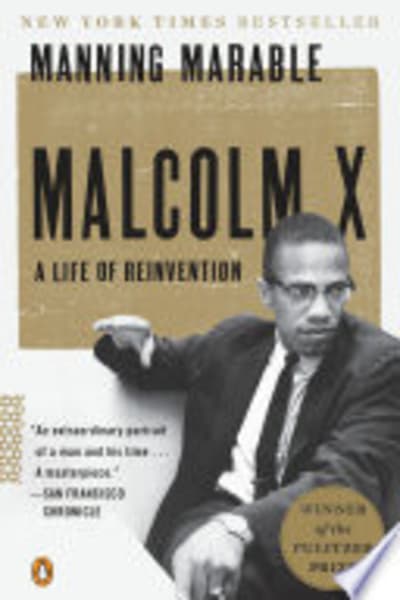
Malcolm X: A Life of Reinvention — Book Summary & Review
Last updated:
Malcolm X: A Life of Reinvention Summary
Marable organizes Malcolm X: A Life of Reinvention around a persistent thesis: Malcolm’s political identity is never fixed, and reinvention is the engine that drives his shifts—from Garveyite family activism, to the Nation of Islam’s discipline, to the broader black-nationalist and internationalist turn right before his death. Marable starts with Malcolm’s early life and the Garvey movement orbit around his parents, then uses Malcolm’s prison years and early Nation of Islam recruitment to show how ideas become routines: study, speech, hierarchy, and the hard economics of respectability. One of Marable’s signature moves is his close attention to Malcolm’s relationships and institutions, treating the Nation of Islam as both spiritual framework and political machine. He also leans on the book’s later sections—especially the lead-up to the assassination—to argue that Malcolm’s break with the Nation was not a vague “conversion” but a strategic rupture with real enemies and real leverage. The writing can feel like a prosecutor’s file: names, dates, organizations, and competing accounts, all marshaled to support Marable’s claim that Malcolm’s story has been flattened by mythmaking on multiple sides. The book’s most vivid concrete example is Marable’s reconstruction of how Malcolm’s public posture hardened as he moved toward a wider coalition, culminating in the assassination narrative Marable frames as “never-before-told” in its specifics.
Here’s the limitation: if you want a short, character-only narrative with minimal archival conflict, Marable will frustrate you. The book is heavy on historiography and disputed details, and it’s not built to be skimmed.
Key Takeaways from Malcolm X: A Life of Reinvention
-
1
Malcolm’s reinvention: Marable treats identity shifts as strategy, not personality change, showing Malcolm adapt to institutions and risks.
-
2
Garveyite family activism: Early chapters link Malcolm’s politics to his parents’ organizing, grounding later rhetoric in inherited networks.
-
3
Nation of Islam discipline: Marable explains how study, hierarchy, and speech training function like a political education system.
-
4
Black nationalism’s pivot: Marable tracks Malcolm’s move from sectarian messaging to broader coalitions and international reference points.
-
5
Assassination reconstruction: Marable uses detailed competing accounts to argue the killing followed Malcolm’s specific rupture, not vague chaos.
Who Should Read This
Someone who’s grown tired of “Malcolm X as legend” versions of history and wants the messy institutional and ideological mechanics behind his changes. If you’re wrestling with how radical figures evolve under pressure—especially when alliances shift and the costs get personal—Marable’s approach lands hard.
Who Shouldn't Read This
If you mainly want a smooth, scene-driven biography with minimal argument and no courtroom-style weighing of sources, you’ll feel bogged down. If you’re looking for a quick orientation to Malcolm X without engaging with Marable’s contested claims, the density and disputes will wear you out.
Editor's Verdict
Marable’s best move is how he uses the book’s reinvention thesis to connect Malcolm’s early Garveyite context, Nation of Islam training, and the final rupture into one continuous logic—especially in the assassination build-up. The real limitation is that Marable prioritizes archival argument and disputed reconstruction over pacing, so readers wanting a lighter narrative may resent the workload. This hits hardest for anyone who’s already read a basic Malcolm X biography and now wants the institutional, political “why” behind the final break and death.
Ready to read Malcolm X: A Life of Reinvention?
Get your copy on Amazon today.
Malcolm X: A Life of Reinvention — Frequently Asked Questions
About Manning Marable
Manning Marable (1950–2016) was an American historian and scholar of African American politics and social movements. He earned a PhD in history from the University of Michigan and taught at Columbia University, where he focused on Black political history. Marable was credible on Malcolm X because his research centered on Black radicalism and the historical development of Malcolm X’s ideas and organizations. His other notable works include How Capitalism Underdeveloped Black America and Malcolm X: A Life of Reinvention.