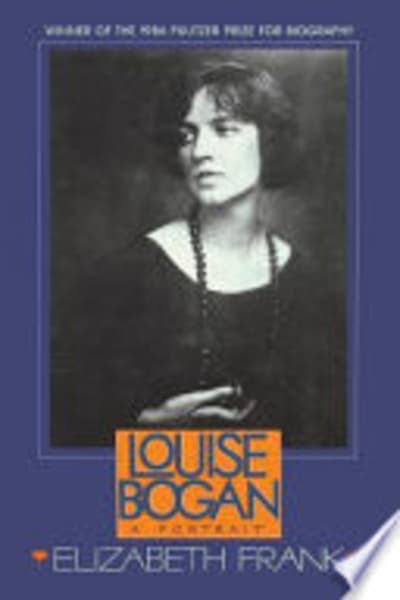
Louise Bogan: A Portrait — Book Summary & Review
Last updated:
Louise Bogan: A Portrait Summary
Elizabeth Frank structures Louise Bogan: A Portrait around a recurring idea: Bogan’s public critical voice and her private poetic discipline are inseparable, and Frank keeps returning to that friction as the engine of the biography. Early on, Frank lays out Bogan as an influential woman of letters in the early twentieth century, then tests that claim against the record—reviews, essays, and the way Bogan guarded her standards even when the literary world rewarded something else. One of Frank’s most useful moves is how she treats Bogan’s criticism as a kind of self-portrait: the same severity that readers hear in the poems shows up in the judgments she makes about other writers. Frank also gives concrete attention to Bogan’s reputation and the cost of it, especially in the book’s middle sections where the narrative starts to feel less like chronology and more like an argument about how taste becomes a form of power.
A specific highlight is Frank’s chapter on Bogan’s critical practice, where she traces how Bogan’s essays refuse easy sentiment and instead demand control of language—an approach Frank frames as both ethical and aesthetic. Frank’s portrait work is at its best when she connects that stance to Bogan’s relationships with editors and institutions, showing how “influential” didn’t mean “protected.” Bogan could be admired and still be sidelined, and Frank insists that readers notice the mismatch.
The limitation: this biography is not a deep, line-by-line guide to Bogan’s poems, so if you’re mainly hunting for close readings or a complete map of her work, Frank’s focus on life, reception, and critical persona may frustrate you. It’s also written with the assumption that you’ll tolerate some archival density rather than getting a breezy, scene-driven narrative.
Key Takeaways from Louise Bogan: A Portrait
-
1
Critical persona: Frank frames Bogan’s essays as a public version of her poetic discipline, not separate from the work.
-
2
Taste as power: Bogan’s standards function socially, shaping who gets attention and how reputations harden or soften.
-
3
Reception history: Frank tracks how admiration and marginalization can coexist, especially through editorial and institutional channels.
-
4
Language control: Bogan’s severity is treated as an ethical stance, demanding precision instead of emotional performance.
-
5
Archival density: Frank leans on documents and judgments, so the biography rewards patience more than momentum.
Who Should Read This
Someone who knows Bogan’s name but feels hazy about how her criticism and poetry connect will probably get real clarity from this portrait. If you’re trying to understand how a writer’s “standards” survive publicity and gatekeeping, Frank’s use of reception and critical voice will click.
Who Shouldn't Read This
If you want a poem-first biography with sustained close readings of individual works, you’ll likely feel shortchanged by Frank’s life-and-stance emphasis. If you dislike archival detail and prefer narrative speed, Frank’s document-driven approach will feel heavy.
Editor's Verdict
The best part of Louise Bogan: A Portrait is Frank’s insistence that Bogan’s criticism is inseparable from her poetry, especially in the chapter that foregrounds Bogan’s critical practice and its demand for language control. The real limitation is that Frank doesn’t deliver the kind of deep, line-by-line poetic analysis many readers will expect from a biography of a poet. This hits hardest for mid-career writers or critics who feel their standards make them harder to “market” and are looking for proof that severity can still build influence.
Ready to read Louise Bogan: A Portrait?
Get your copy on Amazon today.
Louise Bogan: A Portrait — Frequently Asked Questions
About Elizabeth Frank
Elizabeth Frank is a literary scholar and author who has written extensively on modern American poetry, including the work of Louise Bogan. She is credible on Bogan because her research and publications focus specifically on Bogan’s life and writing, culminating in Louise Bogan: A Portrait. Frank has also authored other books on literary history and poetry criticism, including The Beginnings of the Modern: British and American Poetry from the 1790s to the 1830s.