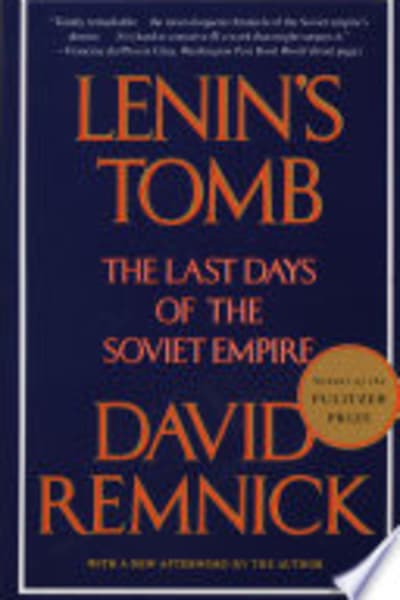
Lenin's Tomb — Book Summary & Review
Last updated:
Lenin's Tomb Summary
David Remnick’s Lenin’s Tomb is built around a recurring method: he braids Party-insider testimony, street-level reporting, and historical context into one long autopsy of Soviet collapse. The book’s signature move is to treat the late USSR not as a single “ending,” but as a chain of choices—some made in Politburo rooms, others in kitchens and prisons—until the system can no longer keep its promises. Remnick repeatedly returns to the tension between official Marxist-Leninist language and the lived reality of shortages, censorship, and fear, then shows how Gorbachev’s reforms collided with a public already exhausted by lies. One of the most vivid sections, “The Tomb,” uses the mausoleum’s strange afterlife as a symbol: Lenin’s preserved body becomes a public ritual masking the regime’s internal decay.
Remnick also gives you the human contradictions that make the collapse feel real rather than inevitable. He tracks how democratic activists and Party loyalists could share the same streets while interpreting the same events with opposite moral vocabularies, and he doesn’t flatten those differences into a tidy morality play. A concrete example is Remnick’s use of figures like Sakharov and Yeltsin to show how reformers learned to speak in the language of rights only after the state’s old guarantees started failing.
Still, Lenin’s Tomb has a limitation: it’s not a guided “how-to” for interpreting current politics, and it can frustrate readers who want a crisp chronology with minimal digressions. Remnick’s reporting style sometimes prioritizes atmosphere and testimony over a strictly linear timeline, so if you crave tidy cause-and-effect bullet points, you’ll have to work for them.
Key Takeaways from Lenin's Tomb
-
1
Lenin’s Tomb framing: Remnick uses the mausoleum’s public ritual to mirror a regime preserving symbols while hollowing out internally.
-
2
Eyewitness journalism method: he treats interviews and scenes as evidence, not decoration, to make late-Soviet politics feel immediate.
-
3
Gorbachev’s reforms collision: Perestroika and glasnost meet a public trained to expect manipulation, turning reform into destabilization.
-
4
Sakharov and Yeltsin contrast: Remnick shows different routes to reform—rights-first moral authority versus power-first political reinvention.
-
5
Party language vs lived reality: official slogans repeatedly fail against shortages, censorship, and fear, until the system loses credibility.
Who Should Read This
Someone who’s trying to understand why the Soviet Union fell without turning it into a simple villain story will probably get a lot out of Remnick. If you’re working through contemporary political cynicism and want to see how institutions collapse when trust evaporates, Remnick’s reporting will land hard.
Who Shouldn't Read This
If you only want a clean, chronological narrative with minimal side paths, Remnick’s structure will feel sprawling and occasionally indulgent. If you’re looking for a practical framework to apply directly to today’s activism, Lenin’s Tomb won’t give you that—its focus is historical reconstruction, not instruction.
Editor's Verdict
The best thing Remnick does is fuse testimony with political analysis, and “The Tomb” is a strong example of how physical symbolism becomes political diagnosis. The real limitation is that the book sometimes sacrifices a tight timeline for atmosphere and layered voices, which will frustrate readers who want strict narrative control. This will hit hardest for anyone who lived through the last decade’s information chaos and keeps asking how systems manage to keep credibility until they suddenly can’t.
Ready to read Lenin's Tomb?
Get your copy on Amazon today.
Lenin's Tomb — Frequently Asked Questions
About David Remnick
David Remnick is an American journalist and editor, best known as the longtime editor of The New Yorker. He has covered Russian and Soviet politics for decades, reporting from the region and writing extensively on the history and legacy of the USSR. His long-form journalism and deep familiarity with Soviet-era sources make him credible on Lenin’s Tomb and related themes. Other notable works include The Bridge: The Life and Rise of Barack Obama and Lenin’s Tomb.