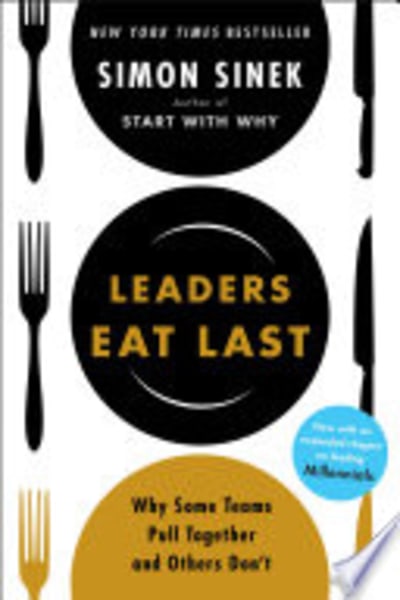
Leaders Eat Last — Book Summary & Review
by Simon Sinek
Last updated:
Leaders Eat Last Summary
Simon Sinek’s “Circle of Safety” is the book’s central framework, and he uses it to explain why some workplaces feel calm enough for people to cooperate while others run on fear and status games. The core story line is anchored in a Marine Corps anecdote—“officers eat last”—where the most junior eat first and the leaders deliberately take less. Sinek argues that this isn’t sentimental theater; it maps to how humans evolved to prioritize group safety. When leaders consistently signal, through action, that they will absorb risk and inconvenience first, people stop scanning for threats and start investing attention in the team’s mission.
From there, Leaders Eat Last becomes part biology lecture, part workplace diagnosis. Sinek repeatedly contrasts “cynicism, paranoia and self-interest” with environments where trust becomes habitual, and he claims that trust is the prerequisite for stable, adaptive teams. He leans on examples across sectors—military, manufacturing, government, investment banking—to show how incentive-only cultures often fail because they don’t create psychological safety. In his telling, a Circle of Safety works like an internal boundary: the outside world is competitive and dangerous, but inside the group there’s a predictable sense that you won’t be sacrificed for someone else’s advantage.
Here’s the honest limitation: Sinek argues big, but he doesn’t offer many step-by-step tools for redesigning culture in a specific company. If you’re looking for a practical playbook, you’ll feel mostly coached at the level of principles and narratives, not implementation. Still, if you’ve ever watched office politics poison performance, Leaders Eat Last gives you a crisp language—Circle of Safety, trust-by-sacrifice—to name what’s going wrong.
Key Takeaways from Leaders Eat Last
-
1
Circle of Safety: Leaders create an internal zone where people feel secure enough to cooperate instead of competing for survival.
-
2
Officers Eat Last: The “eat last” behavior is a signal that risk and inconvenience flow upward, not downward to the powerless.
-
3
Biology of Trust: Sinek frames workplace trust as an evolved response to danger, not a fluffy management preference.
-
4
Trust Beats Incentives: He argues pay and slogans don’t fix fear-driven cultures when safety signals are missing.
-
5
Adaptive Teams: When people belong, the team can shift quickly and focus energy on shared objectives rather than internal friction.
Who Should Read This
If you’re managing a team where people hoard credit, avoid speaking up, or treat every change like a trap, this will feel uncomfortably accurate. Someone who’s trying to rebuild trust after layoffs, restructures, or leadership churn will recognize the pattern Sinek names as a broken Circle of Safety.
Who Shouldn't Read This
If you want concrete HR procedures, metrics, and a “do this next Monday” plan, Sinek’s approach will frustrate you. If you’ve already read Start with Why and hoped for brand-new frameworks with less repetition, Leaders Eat Last may feel like familiar territory with different labels.
Editor's Verdict
The single best thing Leaders Eat Last does is turn the “officers eat last” example into a usable explanation for workplace trust, anchored by the Circle of Safety framework. The real limitation is that Sinek stays mostly at the level of principles and stories, offering too few practical steps to implement cultural change. This will hit hardest for any mid-career leader who’s just burned out on productivity advice and needs a clearer reason why culture keeps collapsing under pressure.
Ready to read Leaders Eat Last?
Get your copy on Amazon today.
Leaders Eat Last — Frequently Asked Questions
About Simon Sinek
Simon Sinek is a British-American author, speaker, and organizational leadership consultant. He was born in London and raised in the UK and the U.S., later studying at the University of Pennsylvania’s Wharton School. Sinek is credible on leadership and organizational behavior through his research, public talks, and work advising leaders on trust, cooperation, and workplace culture. He is the author of Leaders Eat Last and other books including Start With Why and The Infinite Game.