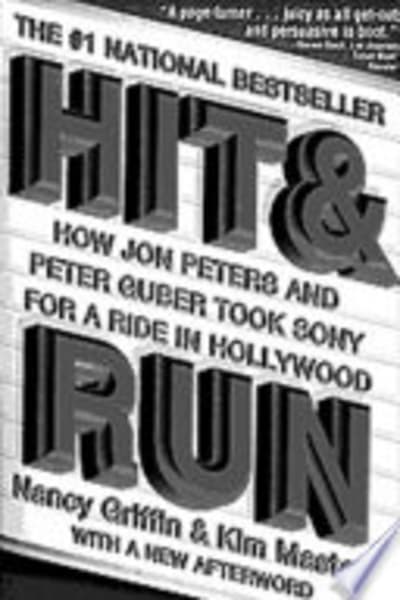
Hit and Run — Book Summary & Review
Last updated:
Hit and Run Summary
Hit and Run is built around Nancy Griffin and Kim Masters’ recurring framework of “spending other people’s money” while Jon Peters and Peter Guber chase studio power, and the book keeps returning to the gap between who gets credit and who actually does the work. Griffin and Masters track how Peters, a former hairdresser with a seventh-grade education, and Guber, his smoother “partner in crime,” position themselves as serious executives while Spielberg, by Griffin’s telling, simply refuses to let them anywhere near The Color Purple’s set. The narrative is structured like a long con that keeps upgrading its pitch: first the film-packager swagger, then the pivot to “studio” legitimacy, then the legal and financial pressure that makes deals possible. One of the book’s most concrete sequences is the Warner Bros. breach-of-contract mess, where Sony’s carelessness shows up as a series of decisions that feel cavalier until Steve Ross at Time Warner turns the screws. Griffin returns to the Milken connection repeatedly, especially the way a top lieutenant helps convert Hollywood hustle into something Sony can’t easily refuse. The Sony history chapters also matter: Griffin and Masters explain why a Japanese corporate culture that is careful in some respects still walked into American entertainment risk with the wrong assumptions. They also underline the book’s central irony—Batman is the exception that proves the rule that Peters and Guber were often absent from the actual creative grind. The limitation is real: this is not a nuts-and-bolts guide to deal-making or media strategy, and readers hoping for an even-handed look at studio craft will feel the focus tilt toward personalities, lawsuits, and corporate maneuvering rather than the filmmaking process itself.
Key Takeaways from Hit and Run
-
1
Film packager mythology: Griffin shows how Peters and Guber sell “executive” status while real production authority stays elsewhere.
-
2
Studio reinvention campaign: The book charts the staged shift from credit-grabbers to deal-makers, complete with selective access to sets.
-
3
Milken lieutenant leverage: It explains how outside finance muscle turns Hollywood credibility into a Sony-sized contract opportunity.
-
4
Warner Bros. breach-of-contract: Sony’s early missteps and stubbornness become the pressure point that lets Time Warner extract value.
-
5
Steve Ross settlement mechanics: The book treats Ross as a closer who uses corporate leverage to force an $800 million-scale resolution.
Who Should Read This
Someone who’s watched flashy operators talk their way into leadership roles and wondered who’s actually doing the work will find this satisfying. If you’re in the middle of a career where reputation outruns results, Hit and Run gives you a case study in how that happens in Hollywood business.
Who Shouldn't Read This
If you want a study of filmmaking craft—directing choices, on-set logistics, or script development—this book will feel lopsided toward lawsuits and power games. If you hate biographies that linger on sex, drugs, and fistfights, Griffin’s and Masters’ tone will frustrate you even when the corporate history gets good.
Editor's Verdict
The best part of Hit and Run is Griffin and Masters’ step-by-step account of how Sony’s Warner Bros. breach-of-contract situation escalates, then turns into Steve Ross’s leverage-driven settlement. The limitation is that the book rarely slows down to evaluate the actual creative work behind the films, so filmmaking fans get less than they want. This hits hardest for anyone mid-career who has just been promoted by narrative—right after you realize the “executive” story is doing more work than the executive reality.
Ready to read Hit and Run?
Get your copy on Amazon today.
Hit and Run — Frequently Asked Questions
About Nancy Griffin
Nancy Griffin is an author and journalist known for writing about crime and public safety. She is credible on the topic of hit-and-run cases through her reporting and research into vehicle-related incidents and their legal and investigative outcomes. Griffin’s work draws on documented court records and public information to explain how these cases are handled. She is the author of Hit and Run and has also written other crime-focused nonfiction titles.