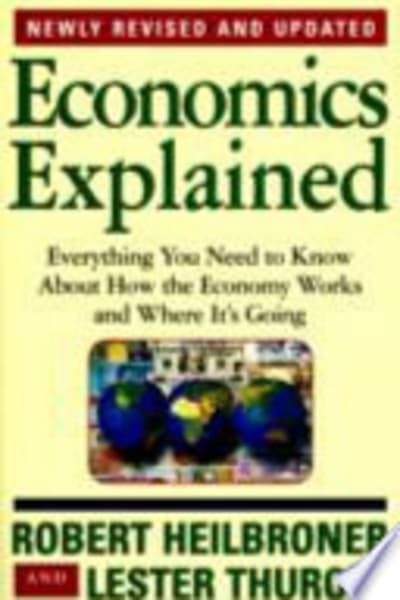
Economics Explained — Book Summary & Review
Last updated:
Economics Explained Summary
Robert L. Heilbroner opens with an explicit “economic way of thinking” framework—scarcity, incentives, and trade-offs—and then keeps testing it against the messier politics of real life, especially in the 1990s U.S. economy. Heilbroner doesn’t treat economics as a bag of formulas; he treats it as an argument about how societies allocate resources and how power shows up in the numbers. One of the book’s most useful moves is pairing basic concepts with concrete outcomes: for example, when he discusses inequality in incomes, he ties the abstraction of market outcomes to the lived experience of wage stagnation and widening gaps. He also returns repeatedly to inflation’s “specter,” using it as a stress test for economic policy—what happens when prices rise, who gets protected, and who eats the cost.
A standout section is the chapter on globalized capitalism, where Heilbroner frames trade and investment flows as incentives that reshape domestic labor markets. He’s especially interested in the political friction created when workers feel the benefits of growth are unevenly distributed. Even when you disagree, the book forces you to specify what you think drives employment, wages, and prices: technology, institutions, policy choices, or some mix of all three. Heilbroner’s tone is brisk and opinionated; he wants you to see the human stakes behind “the economy.”
The limitation is also real: Economics Explained gives you a conceptual tour and historical snapshots, but it doesn’t provide the deeper math, data tables, or policy modeling you’d need to use this as a reference for forecasting. If you’re looking for a rigorous, numbers-first economics text, Heilbroner will feel frustratingly high-level. Still, if you want a clearer, sharper vocabulary for the debates that keep popping up in the news, Heilbroner earns its place on your shelf.
Key Takeaways from Economics Explained
-
1
Economic way of thinking: Heilbroner uses scarcity and incentives to interpret policy debates, not to memorize formulas.
-
2
Inequality in incomes: He connects market outcomes to real wage gaps, showing how distributional questions survive every “growth” story.
-
3
Globalized capitalism: Heilbroner treats trade and investment as incentive systems that reorganize labor markets and political coalitions.
-
4
Specter of inflation: He frames inflation as a policy stress test, asking who pays and who gets shielding when prices rise.
-
5
1990s trends in America: He uses the decade as a case study for applying economic concepts to contemporary headlines.
Who Should Read This
If you’re trying to make sense of why wage growth, inequality, and inflation keep showing up together in workplace conversations, this will give you a usable framework. Someone who’s tired of political slogans and wants a clearer way to talk about economic incentives and outcomes should read Heilbroner before the next big news cycle hits.
Who Shouldn't Read This
If you want an economics book with lots of equations, datasets, and model-based forecasting, Heilbroner’s approach will feel thin and airy. If you prefer chapter-by-chapter depth on one topic (like labor economics or inflation targeting), you may resent how Economics Explained spreads attention across many issues without going all the way down any single rabbit hole.
Editor's Verdict
The single best thing Heilbroner does is connect his “economic way of thinking” framework to the 1990s realities he highlights—especially the inequality and inflation arguments that keep returning. The real limitation is that the book stays conceptual and historical rather than quantitative, so it won’t satisfy readers who want rigorous modeling or data-driven certainty. This hits hardest for anyone mid-career who’s suddenly questioning why the economy feels rigged and wants a clearer vocabulary before arguing politics at dinner.
Ready to read Economics Explained?
Get your copy on Amazon today.
Economics Explained — Frequently Asked Questions
About Robert L. Heilbroner
Robert L. Heilbroner (1919–2005) was an American economist, historian of economic thought, and author. He taught at the New School for Social Research and wrote widely for general audiences about how economic ideas developed and how economies work. He is credible on the topic through his academic work in economic history and his long career explaining economic concepts to non-specialists. Other notable works include The Worldly Philosophers and The Making of Economic Society.