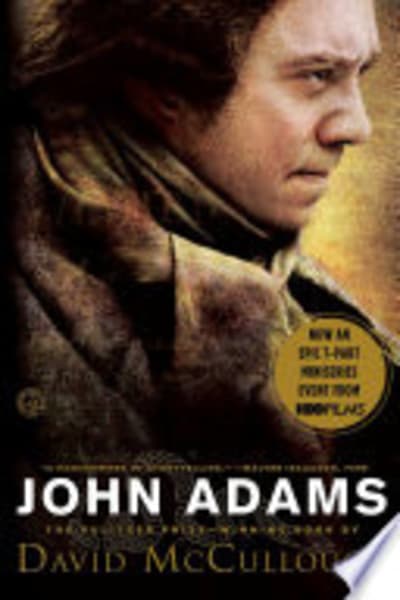
John Adams — Book Summary & Review
Last updated:
John Adams Summary
McCullough structures John Adams around the idea that temperament and principle travel together: Adams’s stubborn honesty, his quick temper, and his legal mind aren’t accessories to the Revolution—they’re the engine. The book moves in big political arcs, but McCullough keeps returning to the small mechanisms of decision-making: how letters get written, how grudges shape cabinets, how a single misread motive can steer a negotiation. One of the clearest examples comes in the section set around the Adams–Jefferson rivalry, where McCullough shows how John Adams can be both right and strategically clumsy, alienating allies even while pushing the country toward independence. Another anchor is the long, intimate focus on Abigail Adams; McCullough treats their marriage as a working relationship that informs his public choices, not a decorative romance. When the narrative reaches the presidency, McCullough’s argument tightens: Adams is portrayed as trying to prevent a needless war through competence and restraint, yet he’s trapped by party politics and the public’s hunger for certainty.
McCullough also leans hard on Adams’s moral language—faith, virtue, and duty—without turning it into a sermon. You feel the cost of being “fiercely independent” when every institution around him rewards compromise. Still, the book doesn’t offer a modern “how to” for readers who want clean, takeaway lessons about leadership; it’s history as lived complexity, with long stretches devoted to correspondence, policy detail, and political maneuvering. If you’re the kind of reader who wants constant forward motion and minimal digressions, you may find the breadth exhausting. And if you already know the headline events of the early republic, some scenes will feel familiar even when McCullough’s character work is vivid.
Key Takeaways from John Adams
-
1
John Adams’s Temperament: McCullough argues personality drives policy, so Adams’s irascibility becomes a political force, not a quirk.
-
2
Revolutionary Correspondence: Letters function like strategy memos, showing how persuasion, insult, and timing shape outcomes more than speeches.
-
3
Abigail Adams as Partner: Their marriage is depicted as intellectual labor that steadies John Adams and sharpens his moral decisions.
-
4
Party Politics Gravity: McCullough portrays factions as weather—unpredictable but constant—pulling leaders toward mistakes even when intentions are good.
-
5
Jefferson Rivalry Mechanics: The book treats rivalry as a system of misread motives, where each man’s certainty fuels the other’s suspicion.
Who Should Read This
If you’re stuck in the “history as dates” habit and want political change explained through character, McCullough’s John Adams will click for you. If you’ve been arguing with friends about leadership and blame—who’s responsible, when, and why—this book gives you a messy, human model.
Who Shouldn't Read This
If you hate long stretches of letters, policy detail, and courtroom-style reasoning, you’ll feel the weight of McCullough’s method. If you want a fast, modern-paced biography with short chapters and constant narrative churn, John Adams will frustrate you.
Editor's Verdict
McCullough’s best move is how he uses the Adams–Jefferson rivalry to show motive, misinterpretation, and strategy colliding, especially around the presidency’s pressure points. The limitation is that the book spends so much time on correspondence and political procedure that it can feel slow if you want pure narrative momentum. This hits hardest for anyone who’s just burned out on simplified political narratives and wants the early republic to feel as complicated as real life.
Ready to read John Adams?
Get your copy on Amazon today.
John Adams — Frequently Asked Questions
About David McCullough
David McCullough (1933–2022) was an American historian and author. He studied at Yale University and worked for the U.S. Office of Education and as a journalist, later writing extensively for major magazines. His credibility on John Adams comes from his long career in historical nonfiction and extensive research into early American political and personal history. McCullough wrote other notable works including Truman (1992) and 1776 (2005).