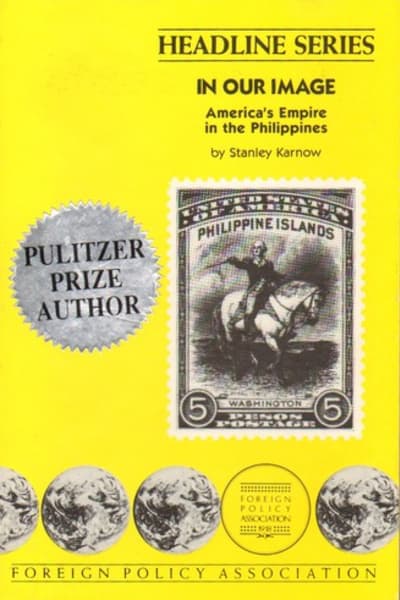
In Our Image: America's Empire in the Philippines — Book Summary & Review
Last updated:
In Our Image: America's Empire in the Philippines Summary
Stanley Karnow organizes In Our Image around the recurring idea that America “screens” the Philippines through its own needs and fantasies, then shows how that filter reshaped politics, policing, and war. The book’s most useful through-line is Karnow’s insistence that U.S. power rarely arrives as neutral administration; it arrives as a moral and strategic story, and that story determines who gets backed, who gets tolerated, and who gets crushed. A concrete example is Karnow’s treatment of the Philippine-American War and the early colonial period, where he emphasizes how quickly “benevolent” rhetoric turns into counterinsurgency logic and how civilians pay first and most. He also returns to the mid-century problem of “stability,” tracing how Washington’s preferences for predictable partners helped harden a political order that could not survive popular pressure.
Karnow’s account of Marcos is where the book’s argument feels sharpest: he lays out how U.S. support functioned less like a one-time gamble and more like an ongoing permission slip, sustained because American officials believed they were choosing the lesser evil. Even when repression becomes undeniable, the machinery of alliance and credibility keeps moving, and Karnow makes you feel the dull momentum of policy. Later, he contrasts the language of democracy with the actual incentives driving decisions, especially as the Philippines becomes a Cold War stage.
The limitation is that In Our Image is broad to the point of crowding: it sketches many eras and personalities, but it won’t satisfy readers who want deep archival detail or a tightly argued single case study from beginning to end. If you came for a granular account of one campaign or one leader, Karnow may leave you wanting more.
Key Takeaways from In Our Image: America's Empire in the Philippines
-
1
American “image” framing: Karnow argues U.S. officials project their own political myths onto the Philippines, then act as if those myths were policy.
-
2
Philippine-American War continuity: he treats early colonial violence as a template, not an exception, shaping later counterinsurgency habits.
-
3
Cold War “stability” logic: Karnow shows stability becomes a justification engine that rewards pliable elites and punishes reformers.
-
4
Marcos alliance incentives: he explains U.S. support as ongoing credibility maintenance, even as repression becomes impossible to ignore.
-
5
Democracy rhetoric vs practice: Karnow tracks the gap between American language and what that language authorizes on the ground.
Who Should Read This
Someone who’s trying to understand why U.S. foreign policy so often produces “partners” who later collapse will find Karnow’s cause-and-effect pattern useful. If you’ve just watched a recent intervention turn into long-term entanglement, Karnow helps you see the incentives and stories that drive the spiral.
Who Shouldn't Read This
Someone who wants meticulous, document-level history of one specific period or leader will likely feel the book’s sweep is too fast and too crowded. If you dislike narrative history that blends politics with moral critique, Karnow’s judgment-laced framing will grate.
Editor's Verdict
The single best thing Karnow does is connect the Philippine-American War era to later Cold War decision-making through the book’s “image” filter, showing how rhetoric becomes action. The real limitation is that the breadth sacrifices depth, so readers craving archival specificity or a fully balanced, single-episode case study will feel shortchanged. This hits hardest for anyone early in a research project on U.S.-Philippines relations who needs a strong map of themes before they go source-hunting.
Ready to read In Our Image: America's Empire in the Philippines?
Get your copy on Amazon today.
In Our Image: America's Empire in the Philippines — Frequently Asked Questions
About Stanley Karnow
Stanley Karnow (born 1935) is an American journalist and author known for reporting on Asia and U.S. foreign policy. He covered the Philippines and the Vietnam War as a correspondent, giving him firsthand expertise on American involvement in the region. His credibility comes from decades of on-the-ground journalism and extensive research. He is also the author of Vietnam: A History and The Forgotten Americans: The Story of the U.S. Prisoners of War in Vietnam.