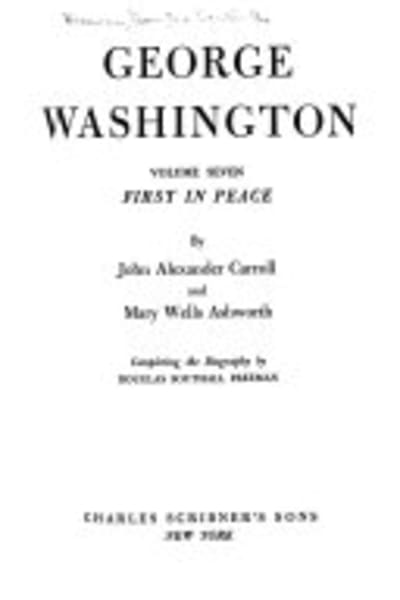
George Washington — Book Summary & Review
by Douglas Southall Freeman, John Alexander Carroll, and Mary Wells Ashworth
Last updated:
George Washington Summary
Douglas Southall Freeman structures his multi-author George Washington around a steady, almost stubborn refusal to mythologize: he insists Washington’s decisions were made under constraints, not destiny. The book leans hard on Freeman’s long-form archival method—showing how Washington’s military and political choices emerged from logistics, political bargaining, and repeated trial-and-error—so you keep seeing the same pattern: principle plus practicality, not one or the other. One concrete through-line appears in the treatment of the Newburgh conspiracy period, where Freeman emphasizes how Washington’s restraint and timing mattered as much as any speech or symbolic gesture. You also get repeated attention to Washington’s role as Commander-in-Chief during the difficult stretches when morale, supply, and command unity were all under stress; the authors don’t let you forget that “leadership” is often just managing bad options. The book’s structure also matters: it alternates between battlefield-level developments, Washington’s correspondence, and the political weather back in Congress, so the narrative keeps snapping back from heroic moments to paperwork realities. Freeman and the other contributors are at their best when they show how Washington’s reputation was built—slowly, unevenly—through actions that looked unglamorous at the time but proved decisive later.
Honest limitation: this is not a quick, personality-first portrait. If you want a clean, chronological “great man” story with minimal digressions, the density of sources and the heavy emphasis on context will likely frustrate you, especially if you’re hoping for a single, simple argument about Washington’s character.
Key Takeaways from George Washington
-
1
Douglas Southall Freeman archival method treats Washington’s life as decisions under constraint, not legend, by foregrounding correspondence and logistics repeatedly.
-
2
Commander-in-Chief focus shows leadership as managing supply, morale, and command unity, not only battlefield brilliance or inspirational speeches.
-
3
Newburgh conspiracy period analysis argues timing and restraint mattered more than theatrical gestures, even when rumors could have detonated discipline.
-
4
Congress and political bargaining framework links military outcomes to legislative bargaining, reminding you the Revolution depended on coordination.
-
5
Reputation-building through uneven actions lens tracks how Washington’s public image formed after the fact, via consistent but unromantic choices.
Who Should Read This
If you’re stuck in the “Washington as statue” mindset and want to understand how he actually made decisions, this will give you the machinery behind the legend. Someone who is willing to read dense historical evidence and follow arguments through letters and political context should enjoy it.
Who Shouldn't Read This
If you want a fast, character-driven narrative with minimal sourcing, the sheer scholarly weight will feel like homework. If you’re looking for a single, neat thesis about Washington’s personality rather than a context-heavy reconstruction, you’ll get impatient quickly.
Editor's Verdict
The single best thing this book does is show Freeman’s constraint-based storytelling through episodes like the Newburgh conspiracy period, where Washington’s restraint and timing do the heavy lifting. The real limitation is that it’s relentlessly archival and context-heavy, so readers who want a streamlined, chronological portrait will struggle. This will hit hardest for anyone who’s already read a casual Washington biography and now wants the messy, evidence-driven reasons behind the Revolution’s leadership choices.
Ready to read George Washington?
Get your copy on Amazon today.
George Washington — Frequently Asked Questions
About Douglas Southall Freeman, John Alexander Carroll, and Mary Wells Ashworth
Douglas Southall Freeman (1906–1961) was an American historian and biographer, trained in historical research and known for meticulous sourcing. He wrote the definitive multi-volume biography of George Washington, making him credible on Washington’s life and times. Other notable works include The Washington (a multi-volume series) and Lee’s Lieutenants. John Alexander Carroll (1906–1980) was an American writer and historian focused on U.S. history. He is credible on Washington due to his scholarship and published historical work centered on Washington. Notable works include Washington: The Making of an American. Mary Wells Ashworth (1913–2002) was an American author and historian who wrote on George Washington with a