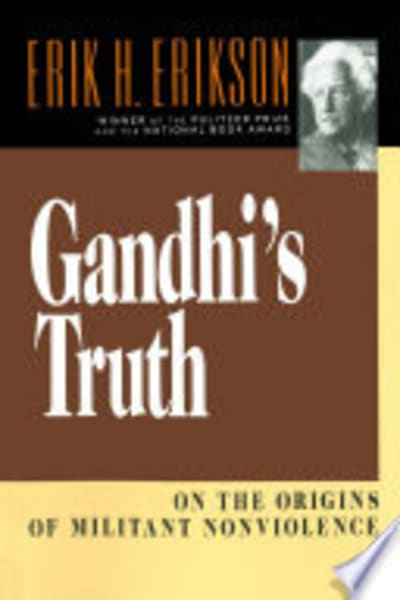
Gandhi's Truth — Book Summary & Review
by Erik Erikson
Last updated:
Gandhi's Truth Summary
Erik Erikson builds his case for Gandhi around a psychoanalytic framework that treats nonviolence as a disciplined emotional economy, not a mood, and he repeatedly ties that discipline to political strategy. The book is organized like a long interpretation in motion: Erikson starts with the psychological pressures inside Gandhi’s life, then tracks how those pressures get refined into a public method—civil disobedience that can survive fear, humiliation, and rage. A specific example Erikson leans on is Gandhi’s turn toward satyagraha, which Erikson frames less as a slogan than as a technique for reorganizing the self so protest can be sustained without collapsing into revenge. Erikson also spends real time on how nationalism and moral imagination braid together: he argues that Gandhi succeeds because he offers Indians a way to feel morally accountable while still acting collectively, and that this emotional “containment” is what keeps mass resistance from turning into chaos.
One chapter readers often remember is “The Roots of Passive Resistance” (as titled in common editions), where Erikson tries to explain why passivity can function as power. He doesn’t pretend the method is effortless; instead, he insists the inner work—what Erikson would call the reshaping of drive and identification—is what makes the outer refusal credible. If you’re expecting a straight political history of the independence movement, Erikson frustrates you: he keeps returning to motives, childhood resonances, and personality dynamics rather than giving you a full timeline of events. Still, the book’s best moments are when Erikson shows how Gandhi’s spiritual language becomes operational in the streets, turning private conflict into public resolve.
Key Takeaways from Gandhi's Truth
-
1
Satyagraha: Erikson treats nonviolent resistance as a practiced inner discipline that makes collective action durable under pressure.
-
2
Passive resistance: Erikson argues it works as power by reorganizing attention away from retaliation and toward moral leverage.
-
3
Psychoanalytic interpretation: Erikson reads Gandhi’s politics through drives, identifications, and emotional regulation rather than only ideology.
-
4
Nationalism: Erikson explains how moral purpose and group identity reinforce each other, preventing protest from dissolving into factional violence.
-
5
Violence vs. nonviolence: Erikson emphasizes that nonviolence still manages aggression; it redirects rather than denies it.
Who Should Read This
If you’re stuck in the “morality talk” vs “strategy talk” argument—where people either preach ethics or obsess over tactics—this will sharpen your thinking. Someone who’s trying to understand how mass movements hold together emotionally, not just organizationally, will likely find Erikson’s approach useful.
Who Shouldn't Read This
If you want a detailed political history of India’s independence campaign with dates, debates, and policy outcomes, Erikson will feel sideways and repetitive. If you dislike psychoanalytic writing—long motive-attribution, speculative psychology—you’ll probably bounce off Erikson’s method.
Editor's Verdict
The single best thing Erikson does is connect satyagraha to an inner mechanism, showing how Gandhi’s emotional discipline becomes a repeatable political practice. The real limitation is that Erikson prioritizes psychological explanation over historical sequencing, so readers seeking a fuller narrative of events will come away unsatisfied. This hits hardest for anyone who’s mid-career questioning why certain movements sustain courage while others burn out quickly.
Ready to read Gandhi's Truth?
Get your copy on Amazon today.
Gandhi's Truth — Frequently Asked Questions
About Erik Erikson
Erik Erikson (1902–1994) was a German-born American psychoanalyst and developmental psychologist known for work on identity and the life cycle. After training in Europe and settling in the United States, he studied personality development across childhood and adulthood, using clinical and historical observation. He is credible on Gandhi’s life because he analyzed Gandhi’s development and moral transformation through a psychological lens in Gandhi’s Truth. Other notable works include Childhood and Society and Young Man Luther.