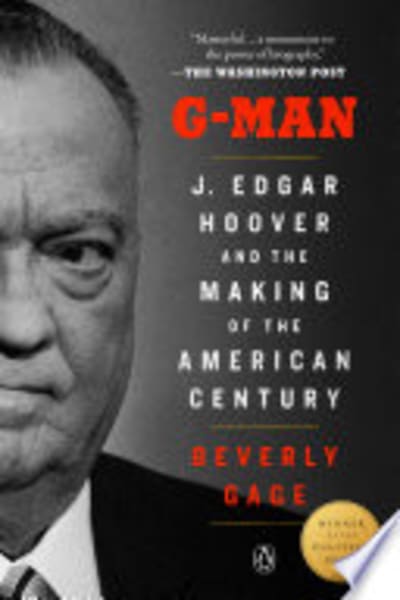
G-Man: J. Edgar Hoover and the Making of the American Century — Book Summary & Review
by Beverly Gage
Last updated:
G-Man: J. Edgar Hoover and the Making of the American Century Summary
In Gage’s G-Man, the central framework is her insistence that Hoover’s rise can’t be explained only by “policing” or only by “politics,” because his power was built by fusing federal law enforcement with ideology, patronage, and racial hierarchy. The book is structured around that fusion: early chapters track how Hoover professionalized a scandal-scarred bureau, then later chapters show how the same bureaucratic instincts hardened into a long-running system of surveillance, leverage, and selective enforcement. Gage repeatedly returns to the idea that Hoover’s “modern machine” was also a personal fiefdom—staffing choices, information control, and the cultivation of allies—so that “law” and “loyalty” became nearly interchangeable.
A concrete example comes from Gage’s treatment of Hoover’s relationships with presidents and political elites: she shows how Hoover learned to stay indispensable by delivering outcomes that fit the moment’s fears, from internal security panics to crackdowns that aligned with white supremacist and Christian-right currents. Another example is her focus on how Hoover’s public posture of moral seriousness masked the bureaucratic machinery he used to target enemies and reward friends; Gage makes it hard to separate the man from the institution he engineered. Even when the narrative describes Hoover’s “triumphs,” Gage’s point is that these were triumphs of coercion, not simply administrative competence.
The limitation: Gage is not trying to write a neutral “case file” of every FBI/Hoover action with equal weight for all controversies. If you want a tightly balanced catalog of each major operation and its evidence, you’ll feel the emphasis tilt toward political culture and ideology over granular procedural detail.
Key Takeaways from G-Man: J. Edgar Hoover and the Making of the American Century
-
1
Hoover’s “personal fiefdom” names how Gage shows institutional power becoming a private network of leverage and access.
-
2
Federal power as ideology means surveillance and policing get framed as moral duty, not neutral administration, in Gage’s account.
-
3
The “deep state” framing explains how Hoover’s bureaucracy could persist beyond elections by cultivating continuity and control.
-
4
Politicized Christian right connections show how Hoover’s targets and alliances reflected religiously coded power struggles.
-
5
Race and governance integration describes how enforcement priorities tracked white-supremacist assumptions inside the state.
Who Should Read This
Someone who’s been watching modern institutions weaponize “public safety” language will find Gage’s story uncomfortably relevant. If you’re trying to understand why federal authority feels both permanent and partisan, G-Man will give you a concrete historical spine.
Who Shouldn't Read This
If you want a lightweight, fast biography with minimal theory and lots of action scenes, Gage’s approach will feel heavy and argumentative. If you came for a procedural play-by-play of FBI operations, you’ll be disappointed by how often Gage zooms out to politics, ideology, and culture.
Editor's Verdict
The single best thing G-Man does is show, through Gage’s sustained focus on Hoover’s fusion of federal policing and political ideology, how his “modern machine” produced power that outlasted individual presidents. The real limitation is that the book prioritizes political culture and institutional patterning over a balanced, operation-by-operation evidentiary catalog. This hits hardest for anyone mid-career who’s realized their workplace “compliance” language can function like ideology—especially if you’re questioning where trust in institutions went wrong.
Ready to read G-Man: J. Edgar Hoover and the Making of the American Century?
Get your copy on Amazon today.
G-Man: J. Edgar Hoover and the Making of the American Century — Frequently Asked Questions
About Beverly Gage
Beverly Gage is an American historian and professor who specializes in U.S. political and cultural history, particularly the history of the American state and the twentieth century. She earned her PhD from Stanford University and has written extensively on J. Edgar Hoover and the FBI. Her expertise comes from years of archival research and scholarship on Hoover-era politics and institutions. She is the author of The Day Wall Street Exploded: A Story of America in Its First Age of Terror and The American Century: The Shaping of a Nation, 1945–1964.