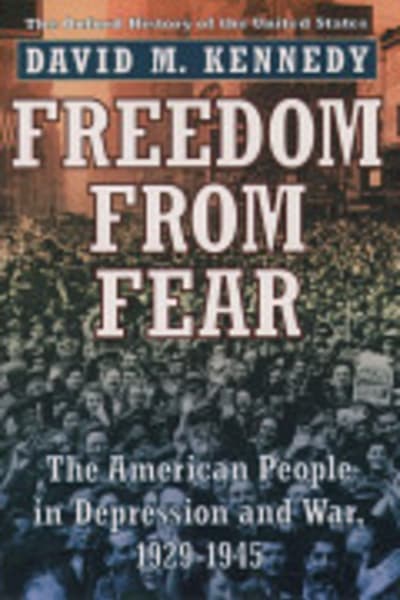
Freedom from Fear — Book Summary & Review
Last updated:
Freedom from Fear Summary
In Freedom from Fear, David M. Kennedy builds a two-track explanation for how Americans survived the Great Depression and World War II: one track is long-run economic boom-and-bust instability, the other is the political choice to translate crisis into the New Deal. Kennedy argues—repeatedly, and with patience—that the 1930s weren’t simply a moral punishment for 1920s excess; the instability goes back “for more than a century,” when industrial capitalism repeatedly churned through booms, layoffs, and misery in both cities and countryside. He then narrows in on the New Deal as a wrenching attempt to reallocate opportunity, while refusing to pretend it was clean or universally effective. Kennedy’s most useful method is his habit of pairing outcomes with contradictions: programs that expanded security also created new exclusions and bureaucratic limits, and he treats those failures as part of the story rather than footnotes.
When Kennedy shifts to the war years, the book’s architecture stays consistent: he connects foreign threats to domestic vulnerability, showing how Hitler exploited Germany’s economic burdens to convert discontent into Nazi loyalty, and how Japan’s imperial ambitions set a parallel stage for catastrophe in Asia. The later half also tackles the American agonizing over strategy and the nuclear-age consequences, including how victory could feel both “sweet” and “ironic,” depending on who you were and what you lost. One chapter/section that crystallizes his approach is his sustained discussion of the New Deal’s “problems and defeats” alongside its achievements, rather than treating reform as a straight line.
Limitation: this is not a thematic, quick-reading book about “fear” as a psychology or personal coping manual; Kennedy stays in the weeds of policy, economic cycles, and diplomatic decisions, and you’ll feel the weight of that if you want a lighter narrative or a narrower focus on one decade.
Key Takeaways from Freedom from Fear
-
1
Long boom-and-bust cycles: Kennedy treats American instability as structural, not accidental, shaping who suffers before 1929.
-
2
New Deal reallocation: Roosevelt’s reforms redirect opportunity, but Kennedy emphasizes exclusions and bureaucratic constraints that limit who benefits.
-
3
Nazi political exploitation: Hitler uses Germany’s economic strain to recruit the disaffected, turning economic pain into party loyalty.
-
4
American strategy determinants: Kennedy links high-level decisions to domestic pressures, industrial capacity, and political constraints under stress.
-
5
Nuclear-age consequences: Victory changes U.S. relationships and risk calculations, creating both triumph and a harsher global posture.
Who Should Read This
Someone who keeps bouncing between big-picture U.S. history and policy history and wants a single author to connect economics, politics, and war planning. If you’re trying to understand why the 1930s and WWII feel like one continuous national stress test, Kennedy’s framework will click.
Who Shouldn't Read This
If you want a crisp, character-driven story with minimal economics, Kennedy’s long-run industrial argument and policy detail will feel heavy. If you’re looking for “how to manage fear” in a personal sense, Freedom from Fear won’t deliver that kind of guidance.
Editor's Verdict
The best thing Kennedy does is insist on a long-run economic foundation—his claim that the Crash grew out of repeated industrial boom-and-bust cycles rather than only 1920s excess. The limitation is that the book is relentlessly broad, so you may finish with a strong synthesis but not the deep focus you’d get from a tighter monograph on one New Deal program or one battle. This will hit hardest for history readers who are mid-career and realizing their understanding of the Depression and WWII is based on slogans, not mechanisms, and they want the mechanisms.
Ready to read Freedom from Fear?
Get your copy on Amazon today.
Freedom from Fear — Frequently Asked Questions
About David M. Kennedy
David M. Kennedy was an American historian and professor known for scholarship on U.S. foreign policy and the Cold War. He taught at Princeton University and wrote widely on American diplomacy and national security. Kennedy is credible on Freedom from Fear’s subject because his research and teaching focus on how U.S. leaders shaped policy and public life during the Cold War. Other notable works include Freedom from Fear: The American People in Depression and War, 1929–1945 and The American People in the Great Depression.