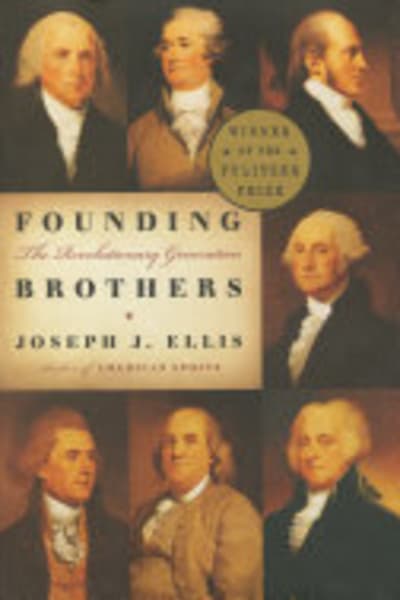
Founding Brothers — Book Summary & Review
Last updated:
Founding Brothers Summary
In Founding Brothers, Joseph J. Ellis organizes the decade after 1790 through six named episodes—Hamilton and Burr’s deadly duel, Washington’s Farewell Address, the Adams marriage partnership, the fight over the capital’s location, Franklin’s push on slavery, and Jefferson and Adams’ correspondence—to show how “ideals” became actual governing machinery. Ellis’s central argument is that the early republic survived less through abstract principle than through messy negotiation among men who were brilliant, ambitious, and frequently incompatible. He keeps returning to a pattern: each episode forces a constitutional or political question that the founding rhetoric never fully answers, so the founders improvise rules of thumb and precedents on the spot. For instance, the Hamilton–Burr duel isn’t treated as gossip; Ellis uses it to expose how honor culture, party conflict, and legal limits collided when political disagreement stopped feeling “safe.” Likewise, the capital debate becomes a study in bargaining power—how geography, symbolism, and factional leverage shaped what the Constitution meant in daily life.
Ellis’s handling of Washington’s Farewell Address is especially sharp: it reads less like moral sermon and more like a deliberate attempt to manage future presidential behavior when no one yet has the muscle memory for modern party politics. When Ellis turns to Adams, he doesn’t let the story float above personality—he shows how John and Abigail Adams functioned like a political feedback loop, with strategy and conscience arguing in the same room. The slavery thread, via Franklin’s attempt to force Congress to confront it and Madison’s counter-moves, is where Ellis sounds most skeptical about the founders’ professed unity. His limitation: the book doesn’t aim to be a full political history of all factions and voters, and it stays tightly focused on a handful of elite actors rather than the broader public. If you want exhaustive detail on every cabinet dispute or legislative vote, Ellis will leave you wanting more; if you want how the Constitution learned to walk, Founding Brothers delivers, and Ellis earns that payoff by the end of each episode.
Key Takeaways from Founding Brothers
-
1
Hamilton–Burr Duel: Ellis treats the duel as a constitutional stress test where party conflict and personal codes collide.
-
2
Washington’s Farewell Address: The speech is framed as behavioral engineering, trying to restrain presidential temptations before party norms harden.
-
3
Adams and Abigail Adams Partnership: The marriage is used as a real political institution, shaping strategy through constant private debate.
-
4
Capital Location Debate: Geography becomes power—symbolic placement and factional leverage determine how “We the People” feels on the map.
-
5
Franklin on Slavery vs Madison’s Block: The book shows how moral urgency loses to political structure when compromise becomes policy.
Who Should Read This
Someone who keeps arguing about whether the Constitution is “working as intended” and wants to see the messy improvisations behind it will likely enjoy Ellis. If you’re burned out on dry constitutional summaries and want character-driven political reasoning centered on the 1790s, this fits.
Who Shouldn't Read This
If you want a comprehensive, event-by-event history of the entire 1790s with broad social context, Ellis’s elite episode structure will frustrate you. If you prefer a purely analytical, least-personal style of political history, Ellis’s emphasis on personality and anecdote may feel too selective.
Editor's Verdict
The best thing Founding Brothers does is use its six episodes—especially the Hamilton–Burr duel—to show how constitutional government was invented under pressure, not declared in speeches. The real limitation is its narrow focus on a small cast of founders, leaving out most voters, institutions, and competing factions that shaped outcomes. This will hit hardest for anyone who’s mid-career and suddenly realizing that “principles” only matter when people negotiate tradeoffs under stress.
Ready to read Founding Brothers?
Get your copy on Amazon today.
Founding Brothers — Frequently Asked Questions
About Joseph J. Ellis
Joseph J. Ellis (born 1943) is an American historian and professor known for scholarship on the early United States. He earned a PhD in history from the Johns Hopkins University and has taught at institutions including Mount Holyoke College and the University of Virginia. Ellis is credible on the Founding era through his academic research and widely reviewed historical writing. His notable works include American Creation and The Quartet: Orchestrating the Second American Revolution.