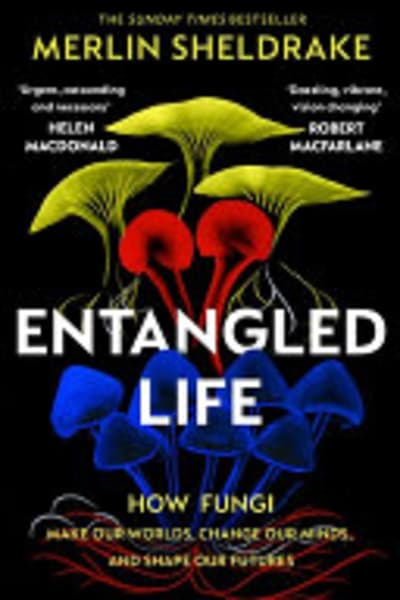
Entangled Life — Book Summary & Review
Last updated:
Entangled Life Summary
In Entangled Life, Sheldrake introduces the striking “Wood Wide Web” concept, showing how fungi build networks that link plant roots. His discussion of mycorrhizal networks is expansive and richly detailed, focused on the symbiotic relationships fungi forge with plants. The book is organized around sharp, unsettling examples: fungi help ferment sugars and may even detoxify pollutants such as TNT. Chapter 5, “Living on the Edge,” lays out the biochemical mechanics that let fungi function in extreme conditions, forcing a reassessment of resilience and adaptation. Still, if you want a straightforward, linear narrative, the book’s meandering structure can feel maddening, with frequent topic switches and no consistent transitions. Sheldrake’s enthusiasm is real, but the information load is heavy, and readers without a strong interest in biology or environmental science may struggle to keep up.
Key Takeaways from Entangled Life
-
1
Wood Wide Web: A fungal network connecting plant roots, facilitating resource exchanges and communication between different species.
-
2
Mycelial Networks: Fungi's underground networks that help decompose organic material, contributing to soil health and plant growth.
-
3
Psychedelic Fungi: Explores their historical and cultural significance, as well as modern scientific interest in their therapeutic potential.
-
4
Bioremediation: Fungi's ability to break down pollutants like plastics and oil, offering sustainable solutions for environmental cleanup.
-
5
Fungal Intelligence: Argues that fungi exhibit problem-solving capabilities, challenging conventional notions of intelligence and consciousness.
Who Should Read This
Someone who finds the intersection of biology and environmental sustainability intriguing will relish this deep dive into fungi. If you're curious about unconventional solutions to ecological challenges, this book offers rich material to ponder.
Who Shouldn't Read This
If you prefer books with a straightforward narrative or are easily overwhelmed by dense scientific detail, this might not be for you. Readers looking for a light, casual read will likely be frustrated by its complexity and depth.
Editor's Verdict
The most impressive aspect of Entangled Life is its vivid descriptions of fungi's potential in bioremediation, especially in tackling pollution. However, it may alienate readers who aren't deeply interested in scientific minutiae due to its dense and technical content. This book hits hardest for anyone pondering solutions to environmental issues or those fascinated by the hidden complexities of natural systems.
Ready to read Entangled Life?
Get your copy on Amazon today.
Entangled Life — Frequently Asked Questions
About Merlin Sheldrake
Merlin Sheldrake is a British biologist and author, renowned for his expertise in mycology. He holds a Ph.D. in tropical ecology from the University of Cambridge, where he studied the interactions between plants and fungi. Sheldrake's credibility in the field is bolstered by his extensive research and academic background. His notable work, "Entangled Life: How Fungi Make Our Worlds, Change Our Minds & Shape Our Futures," explores the complex role of fungi in ecosystems. He also contributed to various scientific publications.