Embers of War — Book Summary & Review
Last updated:
Embers of War Summary
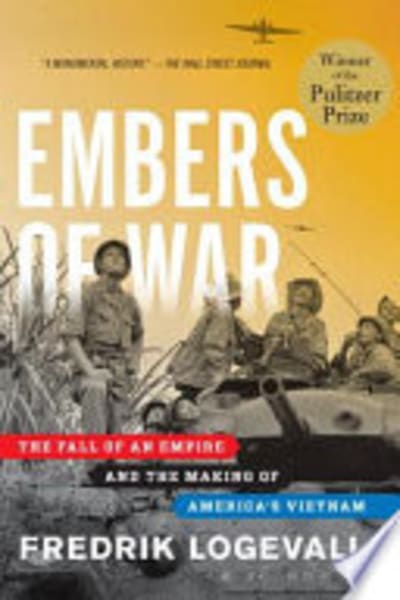
Fredrik Logevall organizes Embers of War around a recurring comparison between French colonial campaigns in Indochina and the U.S. trajectory that followed, using that parallel to explain how policy drift became commitment. Early on, Logevall frames the book’s central engine as a chain reaction: tactical lessons and political pressures reinforce each other until leaders stop seeing escalation as a choice. He keeps returning to the same question—why “limited” interventions keep expanding—by tracing how Washington read events through the lens of credibility, Cold War signaling, and domestic constraints. One concrete example is his treatment of the French fight’s political entanglements: not just who held territory, but how fragile coalitions and legitimacy crises shaped what military options even looked feasible.
In the middle chapters, Logevall’s method shows up as close attention to decision-making rhythms: memoranda, bureaucratic bargaining, and the way intelligence and public narratives get translated into policy language. He also leans on the book’s insistence that political factors were not background noise; they were the battlefield. The comparison is sharpened when he discusses the U.S. shift from advisers to larger roles, arguing that officials often mistook short-term battlefield setbacks for solvable technical problems rather than symptoms of political exhaustion.
A real limitation: Embers of War is dense and chronologically broad across roughly four decades, so readers who want a fast, single-arc explanation of “how the U.S entered Vietnam” will feel buried under context. It’s also less interested in offering neat moral verdicts than in reconstructing how leaders justified themselves while narrowing their own options.
Key Takeaways from Embers of War
-
1
French-American campaign comparison: Logevall uses parallel tactics and political constraints to show escalation as a repeatable pattern, not fate.
-
2
Credibility signaling: U.S. leaders treat restraint as weakness, so every setback demands a larger response to restore trust.
-
3
Policy drift mechanics: bureaucratic momentum and translation of intelligence into talking points steadily convert “temporary” roles into commitments.
-
4
Political legitimacy as battlefield: he argues governance breakdowns and coalition fragility shape outcomes as much as firepower.
-
5
Four-decade scope discipline: the long timeline forces you to track decisions earlier than most Vietnam histories bother with.
Who Should Read This
Someone who’s trying to understand how policy decisions “lock in” over time—like you when a project at work keeps expanding past its original scope—should read Logevall. If you’re in the middle of a political-history binge and want a rigorous explanation of escalation that connects military action to legitimacy and domestic pressures, this will land.
Who Shouldn't Read This
If you only want a tight, post-1964 account of the Vietnam War’s immediate origins, the four-decade reach will feel like detours. If you dislike long, document-heavy narrative and prefer lighter, more interpretive history, Logevall’s method will frustrate you.
Editor's Verdict
Logevall’s best move is the sustained French-American campaign parallel, which he uses to argue that political fragility and credibility pressures made escalation feel “necessary” to decision-makers. The limitation is that the book’s sprawling timeline sacrifices speed and narrative simplicity for exhaustive context. If you’re a policy-nerd who’s ever wondered why leaders keep doubling down mid-crisis, this hits hardest when you’re comparing your own real-world escalation stories to historical ones.
Ready to read Embers of War?
Get your copy on Amazon today.
Embers of War — Frequently Asked Questions
About Fredrik Logevall
Fredrik Logevall is a historian and professor at Harvard University. He specializes in U.S. foreign policy, the Vietnam War, and modern international history. He is credible on Embers of War’s subject because his scholarship focuses on the diplomatic and political dynamics of the Vietnam era and he has published extensively using archival research and primary sources. His other notable works include Choosing War: The Lost Chance for Peace and America’s Vietnam War.