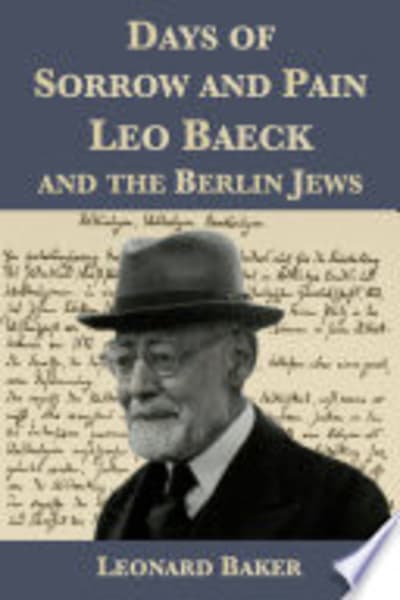
Days of Sorrow and Pain — Book Summary & Review
Last updated:
Days of Sorrow and Pain Summary
Days of Sorrow and Pain is built around Leonard Baker’s parallel focus: the slow collapse of German society and the moral program of Leo Baeck as a working philosophy under Nazi pressure. Baker frames the story through Baeck’s leadership of the Reichsvertretung, showing how that institution tried to manage communal life, organize religious continuity, and negotiate for survival when every official channel was being strangled. One of the book’s most concrete sequences is Baker’s account of Baeck’s repeated arrests—five times, including the moment after he wrote a prayer intended for German synagogues, reminding Jews to bow only to God “in this day of sorrow and pain.” Baker also spends real time on the practical underside of theology: training young men for the rabbinate in Berlin as late as 1942, arranging secret contacts with emissaries abroad to support emigration, and insisting that children still receive religious education even as the ground disappears beneath them. When Baeck is sent to Theresienstadt, Baker doesn’t treat imprisonment as a symbol; he describes the daily labor of hauling trash carts and the night work of organizing educational programs, with Baeck functioning as a stabilizing presence rather than a passive victim. After the war, Baker closes the circle with Baeck’s refusal to chase revenge and his later reconciliation work in liberal Judaism, arguing that individual responsibility doesn’t vanish when history turns murderous. The limitation: this is not a deep dive into Holocaust mechanics or military politics; it’s a biography of one leader, so readers wanting exhaustive detail on camps, policy, or broader Jewish resistance movements may feel the edges are too focused.
Key Takeaways from Days of Sorrow and Pain
-
1
Reichsvertretung: Baker portrays it as a desperate, bureaucratic attempt to protect Jewish communal life under Nazi rule.
-
2
Leo Baeck’s prayer: A recurring moral marker that frames obedience to God as resistance to humiliating coercion.
-
3
Secret emigration contacts: The book highlights quiet negotiation networks rather than dramatic escape narratives.
-
4
Theresienstadt education: Baker treats nighttime teaching as survival work—keeping minds intact when bodies are exploited.
-
5
Reconciliation after 1945: Baeck’s postwar stance is shown as active moral labor, not sentimental forgiveness.
Who Should Read This
Someone who keeps thinking about how moral leadership behaves under state terror should read this, especially if you’re wrestling with what “responsibility” can mean when choices are constrained. If you’ve been reading Holocaust history but want it anchored to one sustained life through Leonard Baker’s research, this will likely satisfy you.
Who Shouldn't Read This
If you want a wide-angle account of Nazi policy, resistance networks, or the full machinery of genocide, this book will frustrate you because it stays locked to Baeck’s biography. If you dislike journalistic, sometimes straightforward historical narration, Baker’s tone may feel too matter-of-fact for your tastes.
Editor's Verdict
Leonard Baker’s best move is using the Reichsvertretung and Baeck’s repeated arrests—including the synagogue prayer sequence—to make theology feel operational, not abstract. The real limitation is that the biography doesn’t try to be a comprehensive study of Holocaust events and policy; it’s intentionally narrower than that. Anyone who’s mid-career and asking what ethics looks like when you can’t control outcomes will feel this hardest while reading Baeck’s Theresienstadt nighttime educational work.
Ready to read Days of Sorrow and Pain?
Get your copy on Amazon today.
Days of Sorrow and Pain — Frequently Asked Questions
About Leonard Baker
I don’t have reliable information about Leonard Baker or the book “Days of Sorrow and Pain,” including their background or other works. Without verifiable sources, I can’t write a factual bio that meets your requirements. If you share a link, publisher page, or brief details (e.g., education, career, subject expertise, publication credits), I can draft a 60–80 word factual bio based strictly on that information.