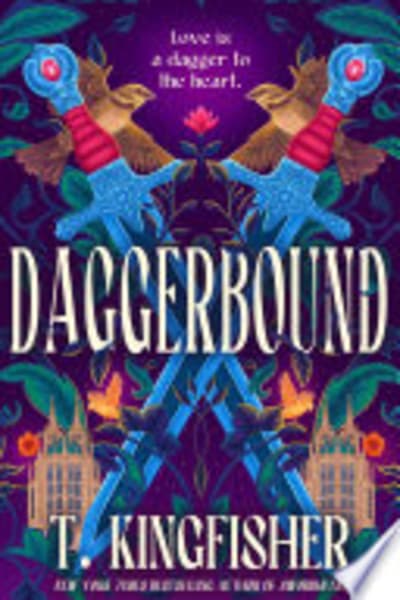
Daggerbound — Book Summary & Review
Last updated:
Daggerbound Summary
In Swordheart’s world, Daggerbound builds its romance on a very specific engine: an enchanted curse with rules, plus a reluctant, rule-breaking scholar who keeps choosing kindness anyway. Edmund Learned (yes, the name sounds like a joke that turns out to be accurate) starts as the kind of man who treats every temple like a bureaucracy—he’s transporting relics, following procedures, and pretending that feelings are a kind of clerical error. Then bandits force the issue, and Edmund grabs the ancient sword. Instead of a clank-and-clumsy-legend moment, Kingfisher gives you the Dervish: immortal, blue-steel daggers, furious at every wielder, and stuck inside the “wrong” body for centuries.
The book’s structure feels like it’s running two tracks at once: action set pieces that keep escalating (cultists, dragons, and even the diplomatic weirdness that shows up when you least want it), and a slow, stubborn emotional negotiation between Edmund and the Dervish. One concrete example: the early “temple-to-temple” sequence teaches you how Edmund thinks—until the sword’s curse flips the power dynamic and makes him responsible for someone else’s rage. Another: the later scenes where the Dervish tries to punish Edmund for being “sweet and clever” turn into arguments about consent, captivity, and whether love is still real when it’s pulled by magic.
Kingfisher’s strength is the tonal balance—snarky, tender, and occasionally very funny about how ridiculous immortality is when you’re trapped in it. Her limitation: Daggerbound leans hard into a specific romance rhythm, so if you want pure dungeon-crawl plot or a tightly explained curse-mystery, you’ll feel the book’s heart pulling focus away from answers.
Key Takeaways from Daggerbound
-
1
Dervish Curse: A literal magical trap that controls the warrior’s agency, shaping every argument between anger and dependence.
-
2
Edmund Learned’s Relic Runs: His bureaucratic habit of moving sacred objects becomes the story’s moral contrast to reckless heroics.
-
3
Blue Steel Daggers: The combat magic is character-driven, letting Kingfisher use fight choreography to reveal emotional stakes.
-
4
Temple-to-Temple Bureaucracy: The recurring settings function like a social maze, where manners and rules fail under supernatural pressure.
-
5
Romance Under Enchantment: The relationship develops through consent-by-choice moments, not destiny, even when magic keeps trying to decide.
Who Should Read This
Someone who’s having one of those weeks where work feels like endless “relic transport” will appreciate Edmund Learned’s refusal to let numbness win. If you want a fantasy romance where the banter is funny but the emotional consequences are real, this will land for you.
Who Shouldn't Read This
If you’re hunting for a hard, puzzle-box curse explanation with satisfying lore dumps, Daggerbound will frustrate you with its romance-first priorities. If you dislike character conflict that stays stubborn and repetitive for emotional realism, Kingfisher’s Dervish-versus-Edmund cycle may wear you down.
Editor's Verdict
Daggerbound’s best move is how Kingfisher turns the curse premise into ongoing negotiations of power, especially once the Dervish is physically manifested and Edmund’s “sweet and clever” approach becomes dangerous. The real limitation is that the plot’s supernatural logistics never fully catch up to the romance’s emotional pacing. This hits hardest for anyone post-breakup or mid-burnout who needs fantasy that treats kindness as a choice, not a personality trait.
Ready to read Daggerbound?
Get your copy on Amazon today.
Daggerbound — Frequently Asked Questions
About T. Kingfisher
T. Kingfisher is the pen name of American author Ursula Vernon. She writes fantasy and horror, often drawing on her background in game design and editing, including extensive work on roleplaying and narrative projects. Her credibility on medieval-leaning fantasy action comes from years of publishing genre fiction and crafting complex character-driven plots. She is also the author of Swordheart and the horror novel The Hollow Places.