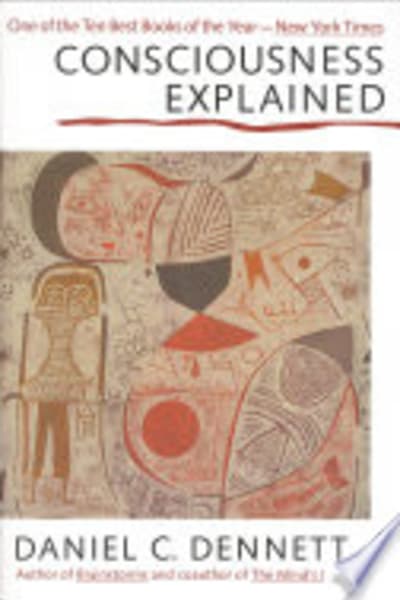
Consciousness Explained — Book Summary & Review
Last updated:
Consciousness Explained Summary
Dennett’s “multiple drafts” framework is the spine of Consciousness Explained, and the book keeps returning to one provocation: the stream of consciousness isn’t a single movie running end-to-end inside you. Instead, Dennett argues your mind is more like a parallel-processing “virtual machine” that generates competing drafts, which get stabilized by attention, memory, and later interpretation. He attacks the Cartesian feel of consciousness—the idea that there’s a private inner theater where experience is assembled and presented—by treating introspection as data that can be edited after the fact. One recurring move is to replace “What is consciousness, as a unified thing?” with “What functional work does consciousness appear to do, and how could evolution yield that?”
A concrete example is Dennett’s discussion of introspective reports in relation to timing: what you confidently say you experienced often lines up with when your system can produce a coherent narrative, not with a single moment of inner presentation. He also takes on the “self” and the ego as an organizing fiction, insisting that the self is an effect of narrative-making rather than an extra ingredient in experience. His treatment of non-human minds pushes the same method: ask what kinds of information processing and behavioral control would count as relevant “levels” of consciousness.
This book will frustrate readers who want a clean, final definition of consciousness or who prefer qualitative, first-person descriptions over functional and computational explanations. Dennett argues aggressively, but he doesn’t slow down to build a shared vocabulary with every competing tradition; you’ll have to keep up.
Key Takeaways from Consciousness Explained
-
1
Multiple drafts: consciousness is not one inner timeline but competing representations that get revised and stabilized.
-
2
Virtual machine: the mind is an interpretive software-like level, not a ghostly substance watching the brain.
-
3
Introspection as evidence: self-reports track narrative output and post-processing, not a privileged access to raw experience.
-
4
Cartesian theater: Dennett rejects the idea of a single inner screen where experience is assembled for an audience.
-
5
Levels of consciousness: non-human minds can qualify via functional complexity, not human-like introspective access.
Who Should Read This
If you’re stuck in the “where is experience happening?” loop—especially after reading neuroscience headlines that still sound dualist—Dennett gives you a workable alternative. Someone who enjoys arguing with their own intuitions about introspection will have a field day with Dennett’s multiple-drafts critique.
Who Shouldn't Read This
If you want a gentle, patient tour of theories with lots of summaries of competing views, Dennett’s style will feel combative and fast. If you came for a comforting, first-person account of consciousness, Dennett will frustrate you by treating that “inner theater” as a mistake.
Editor's Verdict
Dennett’s multiple drafts framework is the best part, especially when he uses introspective timing to show why your certainty about experience can be systematically misleading. The limitation is that Consciousness Explained refuses to deliver a single, final definition of consciousness that satisfies readers seeking closure. This hits hardest for anyone mid-career who keeps bumping into the hard problem at parties and wants a method for arguing back, not a poetic answer.
Ready to read Consciousness Explained?
Get your copy on Amazon today.
Consciousness Explained — Frequently Asked Questions
About Daniel C. Dennett
Daniel C. Dennett (born 1942) is an American philosopher and cognitive scientist known for work in philosophy of mind and consciousness. He earned his PhD at Harvard University and has taught at several institutions, including Tufts University. Dennett is credible on consciousness because he has published extensively on cognitive science, mental representation, and theories of consciousness. Notable works include Consciousness Explained (1991) and The Intentional Stance (1987).