Charles Evans Hughes — Book Summary & Review
Last updated:
Charles Evans Hughes Summary
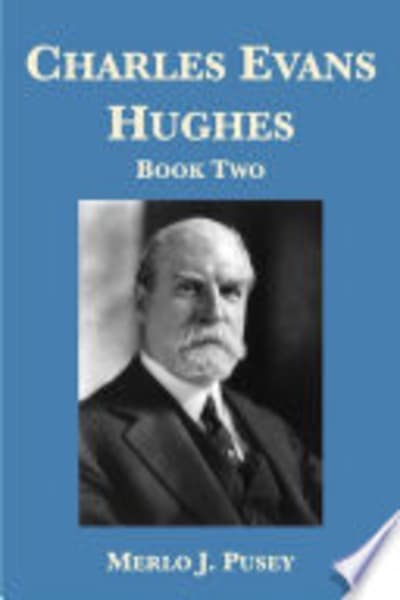
Charles Evans Hughes is organized around Hughes’s public life as it collides with the legal and political machinery of the early 20th century, and Merlo J. Pusey’s method is to keep that collision in view rather than treating Hughes like a stand-alone saint or a convenient foil. Pusey repeatedly uses Hughes’s paper trail—letters, speeches, and the “authorized” materials Hughes left behind—to show how a careful mind behaves under pressure: in the Supreme Court’s posture, in the Republican Party’s internal fights, and later in the national crisis years when questions of authority stop being abstract. One concrete example is how Pusey frames Hughes’s judicial temperament through recurring decisions and administrative choices, then contrasts that with Hughes’s political instincts when he’s forced into public leadership. Another is Pusey’s attention to Hughes’s family life as a stabilizing counterweight; it’s not decorative, because it helps explain why Hughes’s self-discipline reads less like performance and more like habit. Pusey also leans hard on the “half century of our political-judicial history” idea—meaning the book constantly widens the lens to show what Hughes could and couldn’t control, and why that matters for judging him fairly.
The limitation is real: this is not a quick, narrative-driven biography. At roughly 829 pages, Pusey’s pace can slow when he’s documenting controversies and assembling context, and the book avoids big philosophical arguments about justice in favor of chronology and evidence. If you want a short, interpretive portrait that boldly psychoanalyzes Hughes, you’ll likely feel the book keeps its distance—Pusey’s restraint is part of the point, but it can also frustrate.
Key Takeaways from Charles Evans Hughes
-
1
Hughes’s paper trail: Pusey builds arguments from letters and documents, so you feel how Hughes’s thinking changed over time.
-
2
Judicial temperament: The biography tracks Hughes’s decision-making style, showing how restraint becomes strategy in high-stakes cases.
-
3
Political-judicial context: Pusey constantly widens the lens, explaining how legal outcomes were shaped by party politics and crises.
-
4
Family life as evidence: Domestic detail functions as explanatory context for Hughes’s self-discipline, not as sentimental filler.
-
5
Pusey’s documentary method: The prose stays measured and evidence-first, which makes the work reliable even when it’s slow.
Who Should Read This
If you’re knee-deep in law-and-politics history and want to understand how one figure’s mind worked inside institutions, this will reward your patience. Someone who’s preparing for a job interview, scholarship application, or exam on American courts will benefit from Pusey’s document-heavy clarity.
Who Shouldn't Read This
If you’re looking for a fast, character-first biography with lots of psychological interpretation, you’ll feel the book’s restraint and pacing. If you only want a tight sketch of Hughes’s achievements without the surrounding controversies, Pusey’s context will feel like reading homework.
Editor's Verdict
The best thing this book does is make Hughes’s judicial and political choices legible through Pusey’s documentary approach—especially in the way Hughes’s roles are treated as evidence of temperament, not just résumé items. The real limitation is that Pusey avoids bold interpretation and can bog down in the context-heavy documentation you didn’t come for. Anyone who’s burned out on glossy leadership biographies will likely find Hughes’s method of self-discipline most satisfying when they’re ready to read slowly and verify claims.
Ready to read Charles Evans Hughes?
Get your copy on Amazon today.
Charles Evans Hughes — Frequently Asked Questions
About Merlo J. Pusey
Merlo J. Pusey was an American historian and biographer, best known for writing about U.S. political and judicial figures. He was credible on the subject of Charles Evans Hughes because his work drew on extensive historical research and documentation, producing a detailed, source-based account of Hughes’s life and career. His notable works include The Supreme Court and the Constitution and Charles Evans Hughes.