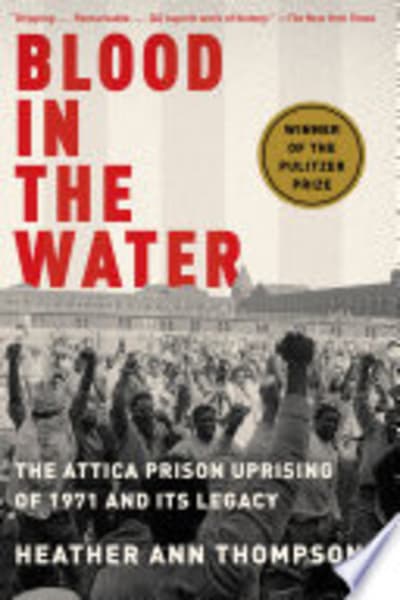
Blood in the Water — Book Summary & Review
Last updated:
Blood in the Water Summary
Heather Ann Thompson builds Blood in the Water around a legal and political sequence: how Attica’s September 9, 1971 rebellion was framed as criminal disorder, then fought over in court for decades, with the state repeatedly trying to manage the story. Thompson structures the book around the rebellion’s internal logic (negotiations, hostage demands, the rebels’ aims) and the external machinery that crushed it (Rockefeller’s decision to deploy an assault force, law enforcement planning, and the post-raid cover-up). One of the book’s most concrete anchors is her discussion of the hostage-and-negotiation window after the prison takeover, followed by the assault that left 29 rebels and 10 hostages dead and more than 100 seriously wounded. Thompson then tracks what happened after the guns: how claims of torture and abuse were handled, minimized, or buried, and how families and survivors had to fight for years to force accountability. She also treats the aftermath as its own battleground, where legal victories and setbacks were shaped by politics as much as evidence, culminating in protracted litigation that stretched until 2005.
The book does not read like a single straight narrative; Thompson often zooms out to show how penology, policing, and “order” rhetoric worked together. Even so, the writing stays grounded in specific actors and documents. Honest limitation: if you want a character-driven memoir-style account of Attica’s men or a detailed blow-by-blow of every negotiation moment, Thompson’s focus on institutions and court battles will frustrate you, and the prison’s day-to-day voices can feel thinner than the headlines suggest. Still, Thompson’s insistence that the rebellion and the cover-up are inseparable is what makes Blood in the Water worth the time and money for readers who care about how violence gets authorized and then archived.
Key Takeaways from Blood in the Water
-
1
Attica Prison takeover: Thompson shows how the rebellion’s initial seizure created leverage before negotiations hardened positions.
-
2
Rockefeller assault decision: The book explains how executive power translated into operational planning and lethal force within days.
-
3
Hostage negotiation window: Thompson treats the talks as a political strategy, not a pause, and tracks how demands were structured.
-
4
Torture allegations: She documents how abuse claims were handled through institutional denial and procedural delay.
-
5
Protracted legal battles: Thompson argues that courts became a second arena where accountability was contested until 2005.
Who Should Read This
If you’re trying to understand how a state response to prison unrest becomes a long-running legal and political story, this will fit. Someone who’s followed modern policing controversies and feels the pattern of “order” rhetoric versus accountability will likely stay engaged with Thompson.
Who Shouldn't Read This
If you want a fast, scene-by-scene account with lots of intimate interiority from the incarcerated men, Blood in the Water will feel institutional and document-heavy. If you’re only interested in the four-day crisis itself and not the decades-long courtroom struggle, Thompson’s extended aftermath chapters will test your patience.
Editor's Verdict
Heather Ann Thompson’s best move is linking the rebellion’s hostage-and-negotiation phase to the later cover-up, showing how each phase shapes the next. The limitation is that the book prioritizes institutions, filings, and political framing over vivid, prison-level storytelling. Anyone who’s ever wondered why Attica keeps resurfacing in political arguments—especially when you’re in a “history of policing” research phase—will get the most from Blood in the Water.
Ready to read Blood in the Water?
Get your copy on Amazon today.
Blood in the Water — Frequently Asked Questions
About Heather Ann Thompson
Heather Ann Thompson is a historian and professor known for research on twentieth-century U.S. policing and mass incarceration. She earned her PhD from the University of Michigan and has taught at the University of Michigan. Thompson is credible on carceral history because her work is grounded in extensive archival and primary-source evidence. Her notable books include Blood in the Water and Blood in the Water: The Attica Prison Uprising of 1971.