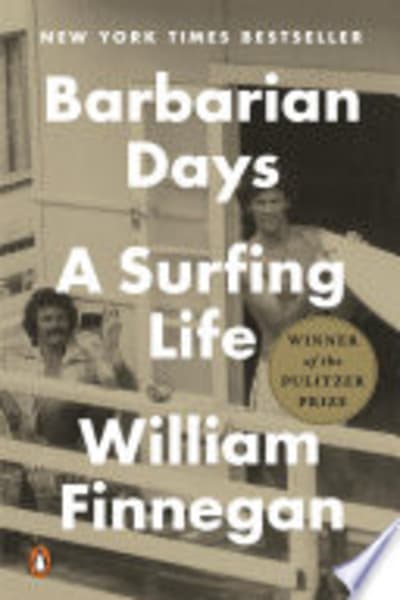
Barbarian Days: A Surfing Life — Book Summary & Review
Last updated:
Barbarian Days: A Surfing Life Summary
Barbarian Days: A Surfing Life is built around Finnegan’s habit of treating surfing as fieldwork in motion—he’s always watching people, not only waves. The book moves through distinct phases: childhood apprenticeship in California and Hawaii, then years of roaming with a journalist’s hunger, then the odd turn into something like an anthropologist when Finnegan can’t stop studying how cultures organize desire, work, and power. Finnegan gives you the sensory mechanics of famous breaks, but he also insists the real education is social: who gets to be “in,” who gets shut out, and what boys will do to prove they belong. One of his most vivid anchors is the Honolulu school episode where he’s in a whites-only gang while his closest friend is a native Hawaiian surfer—Finnegan never pretends the friendships are simple, and the surf makes that contradiction feel physical. He also leans into the 1960s upheaval as a constant pressure system, showing how generational swagger, drugs, and ideology collide with reef charts, saltwater patience, and the risk of getting it wrong. When Finnegan describes dropping LSD while riding huge Honolua Bay, the tone stays rueful rather than preachy: the point isn’t “look how wild,” it’s how easily a kid mistakes intensity for meaning. Another recurring structure is the way he pairs technical wave talk with moral danger—whitewater bravado can slide into recklessness, and he admits his own. Finnegan’s limitation is that he doesn’t slow down long enough to fully map outcomes; you’ll feel the costs, but the book rarely stops to deliver a tidy thesis about what surfing “fixes” in a life. If you want a clean, chronological memoir with a single argument, Finnegan’s roaming, episodic method may leave you wanting more shape than it provides.
Key Takeaways from Barbarian Days: A Surfing Life
-
1
Surfing as fieldwork: Finnegan treats each trip like research, using waves to read people’s rules, hierarchies, and taboos.
-
2
Reef charts and apprenticeship: knowing a break means studying local knowledge, not heroics; Finnegan shows learning as slow and communal.
-
3
Honolulu whites-only gang: Finnegan frames belonging as conflict, with surfing revealing the tension between race, loyalty, and friendship.
-
4
Honolua Bay LSD episode: the drug detail isn’t shock value; it’s Finnegan admitting how thrill can masquerade as insight.
-
5
Anthropologist-by-accident: Finnegan’s “study” mode shows up in Samoan fishing village and Tongan interactions, but it’s messy.
Who Should Read This
Someone who’s stuck in a job where “writing” feels separate from living—like you clock in, then go home empty—will probably love how Finnegan refuses that split. If you’ve spent years chasing a hobby that keeps turning into identity, Barbarian Days gives you a language for the addiction, the ethics, and the education.
Who Shouldn't Read This
If you want a tightly structured memoir that proves a single argument from start to finish, Finnegan’s roaming, episodic approach will feel like drift. If you’re mainly there for surf technique, you’ll get plenty of wave talk but the book keeps turning outward to politics, race, and sex rather than staying on board mechanics.
Editor's Verdict
The single best thing Barbarian Days does is braid technical surf detail with social consequence, especially in the Honolulu whites-only gang sequence where Finnegan’s friendships are tested in real time. The real limitation is that Finnegan rarely pauses to synthesize—he documents, he doesn’t fully adjudicate, so some readers will want clearer conclusions about what all this adds up to. This hits hardest for anyone in their late 20s to mid 30s who’s starting to suspect their “passion” is also a form of self-mythmaking and needs a messy reality check.
Ready to read Barbarian Days: A Surfing Life?
Get your copy on Amazon today.
Barbarian Days: A Surfing Life — Frequently Asked Questions
About William Finnegan
William Finnegan is an American journalist and author. He grew up in the United States and worked as a foreign correspondent, covering major global events for The New Yorker and other outlets. His long-term reporting and firsthand travel experience make him credible to write about surfing culture and history. He is best known for Barbarian Days: A Surfing Life (2000). Other notable works include The Way to Nowhere (1996) and Cold Wind, Warm Wind (2018).