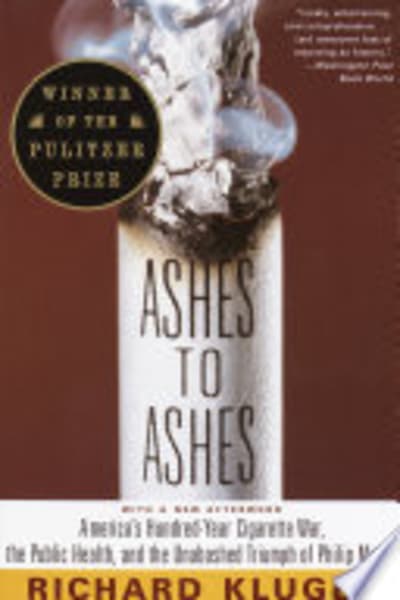
Ashes to Ashes — Book Summary & Review
Last updated:
Ashes to Ashes Summary
Richard Kluger organizes Ashes to Ashes around a blunt, recurring thesis: the cigarette’s success wasn’t an accident of chemistry or taste, but the product of coordinated industry strategy—corporate, political, and promotional—matched against public-health opponents who were often outgunned on money and timing. Early on, Kluger lays out the “cigarette wars” as a long contest over scientific credibility, using the industry’s habit of sponsoring research while fighting regulation as the central mechanism of delay. He threads the story through the dynasties—Duke and Reynolds—then pivots to figures like George Washington Hill and Joseph F. Cullman, showing how personality and corporate culture translated into marketing muscle and regulatory pressure. One concrete anchor is the book’s attention to the industry’s public-relations playbook: Kluger repeatedly returns to how messaging could sound cautious while internal evidence and incentives pushed toward continued sales.
A major payoff is how Kluger connects tactics to outcomes. He doesn’t treat addiction as a side note; he treats it as the business model that made “self-destruction” profitable, especially once cigarettes became the modern, mass-produced delivery system. He also takes seriously the political economy—tax revenue, lobbying, and the way entire communities could be economically invested in tobacco—so policy fights look less like moral debates and more like fights over institutional leverage. If you want a single through-line, it’s this: the industry learned to manage uncertainty, fund controversy, and keep the spotlight away from lethal consequences long enough to win market share.
Limitation: Ashes to Ashes is dense and sprawling, with a heavy emphasis on American corporate and governmental maneuvering; if you’re searching for a tight, personal narrative or a clear “how we fix this” blueprint, Kluger gives you history, not a cure plan.
Key Takeaways from Ashes to Ashes
-
1
Cigarette wars: Kluger frames regulation as a multi-decade contest where credibility, timing, and money decide outcomes.
-
2
Duke and Reynolds dynasties: The book treats family-led corporate culture as a driver of strategy, not just background color.
-
3
George Washington Hill: Hill represents a type of operator who turns eccentric leadership into aggressive market and political influence.
-
4
Joseph F. Cullman: Cullman shows how marketing sophistication can coexist with internal knowledge that challenges public claims.
-
5
Industry public-relations spinners: Kluger documents how messaging can generate doubt while sales incentives keep moving forward.
Who Should Read This
Someone who keeps running into “it’s complicated” arguments about tobacco—especially ones that blame individual choice more than systems—will want Kluger’s evidence-heavy framing. If you’re trying to understand how industry power reshapes science and policy in real time, Ashes to Ashes gives you a historical map of the tactics.
Who Shouldn't Read This
If you’re looking for a streamlined narrative with short chapters and minimal corporate detail, this book’s sprawl will feel exhausting. If you want practical prevention or treatment guidance, Kluger’s focus stays on history and maneuvering, not on solutions.
Editor's Verdict
The best part of Ashes to Ashes is Kluger’s sustained explanation of how the industry fought antismoking science and government pressure by managing uncertainty—an argument that keeps paying off as the “cigarette wars” escalate. The real limitation is that it’s relentlessly broad and information-dense, so readers who want a lean, emotionally paced story will feel stalled. This hits hardest for anyone who’s mid-career and realizes their workplace debates about “data vs. politics” sound exactly like the tobacco-era fights Kluger documents.
Ready to read Ashes to Ashes?
Get your copy on Amazon today.
Ashes to Ashes — Frequently Asked Questions
About Richard Kluger
Richard Kluger is an American journalist and author known for writing about the Holocaust and its aftermath. He worked as a reporter and editor, including at major U.S. newspapers, and has spent decades researching primary sources and survivor testimony. He is credible on this topic because his nonfiction is grounded in extensive archival work and interviews. Kluger’s other notable works include The Paper and the Sword and The Triumph of Jews and the Holocaust.