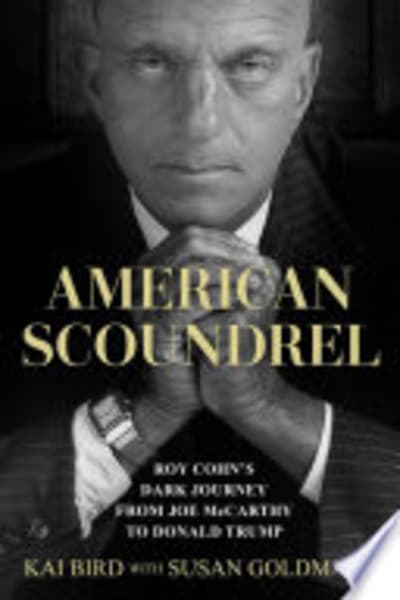
American Scoundrel — Book Summary & Review
by Kai Bird with Susan Goldmark
Last updated:
American Scoundrel Summary
American Scoundrel is built around Bird and Goldmark’s insistence that Roy Cohn’s methods—especially his fusion of legal power, media management, and personal grievance—became a template for modern political performance. The book’s spine is chronological, but it keeps snapping back to one recurring mechanism: Cohn’s ability to turn private contempt and public spectacle into leverage, whether he’s prosecuting the Rosenbergs, serving as McCarthy’s right hand, or acting as the Mafia’s “lawyer” with a grin that made intimidation feel like charm. One of the most concrete through-lines is how Bird and Goldmark track Cohn’s “daily telephone” mentoring of Donald Trump, using it as evidence that Cohn wasn’t merely an era’s villain—he was an instructor in posture, rumor-handling, and grievance-as-policy.
A standout portion is the section dealing with Cohn’s communist-hunting years, where Bird and Goldmark show how the courtroom became a stage and how Cohn treated evidence like something to be arranged rather than tested. Later, they widen the frame: the Studio 54 years and the Reagan White House visits are not decorative trivia; they’re part of the argument that elite parties and official power were just different lighting for the same performance. Bird and Goldmark also weave in the Tony Kushner afterlife—how Angels in America crystallized Cohn’s tensions into cultural shorthand—while still insisting on the historical person behind the myth.
Limitation: this is not a story that slows down to offer comfort or deep psychological interiority for every figure around Cohn. If you want a clean, sympathetic arc or a strictly legal analysis of every case, Bird and Goldmark will frustrate you with their focus on patterns of influence and public theater.
Key Takeaways from American Scoundrel
-
1
Roy Cohn’s “template” function explains how law, rumor, and media attention fuse into power rather than staying separate.
-
2
McCarthy-era courtroom staging shows evidence can become props when the goal is dominance, not truth-finding for its own sake.
-
3
Mafia legal gun framing clarifies how Cohn monetized intimidation, using legal language to launder coercion into respectability.
-
4
Studio 54 and Reagan White House episodes prove elite access was part of the same brand-management system, not a detour.
-
5
Angels in America lens treats Kushner’s portrayal as cultural amplification while Bird ties it back to archival behavior.
Who Should Read This
If you’re watching politics feel increasingly like reputation warfare—where optics outrun facts—this book will sharpen the pattern-spotting in your head. Someone who’s tired of vague “corruption” talk and wants a concrete lineage from Cohn to modern political style should read American Scoundrel.
Who Shouldn't Read This
If you want a purely legal, case-by-case walkthrough with courtroom transcripts as the main event, you’ll likely feel the book moving too quickly between eras. If you dislike biography that leans hard on media spectacle and cultural aftermath, Bird and Goldmark’s emphasis will feel repetitive instead of illuminating.
Editor's Verdict
The best part of American Scoundrel is Bird and Goldmark’s repeated demonstration that Cohn’s courtroom tactics and brand-management habits connect across decades, culminating in the Trump mentorship thread. The limitation is that the book prioritizes influence patterns over sustained, granular analysis of the individual cases themselves. This will hit hardest for anyone mid-career who suspects their news diet rewards performance—and then wants to trace where that incentive structure came from.
Ready to read American Scoundrel?
Get your copy on Amazon today.
American Scoundrel — Frequently Asked Questions
About Kai Bird with Susan Goldmark
Kai Bird and Susan Goldmark are American journalists and authors who have written extensively about U.S. political history and wartime intelligence. Bird is known for award-winning historical reporting and biographies, including The Chairman and The Good Spy. Goldmark is a journalist and coauthor with Bird on American Scoundrel, a detailed account of the life and influence of Joseph R. McCarthy. Their credibility comes from long-form research, archival work, and publication track records in modern American history.