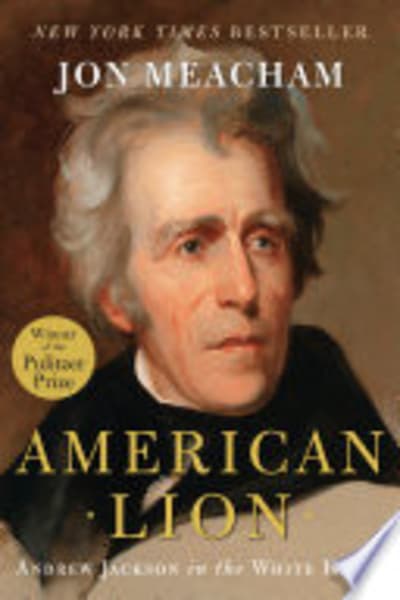
American Lion: Andrew Jackson in the White House — Book Summary & Review
by Jon Meacham
Last updated:
American Lion: Andrew Jackson in the White House Summary
Jon Meacham structures American Lion around the claim that Andrew Jackson didn’t merely “lead”—he redesigned the presidency by treating Washington as something to be captured, not consulted, and Meacham keeps proving that point through the book’s tight political-and-personal braid. Early on, Meacham frames Jackson as a man who spoke for “the people” while also running on fear, grievance, and control; the contradiction is the engine, not a footnote. A standout thread is how Jackson’s White House power grows from campaign-era politics into governing machinery, especially as Meacham zooms in on the inner circle of advisers and the family letters that reveal how Jackson’s private emotions fed public decisions.
One concrete example: Meacham’s treatment of Jackson’s approach to political legitimacy—his insistence that popular will outranks elite process—shows up repeatedly as an operating principle for policy and for conflict. Another: the book lingers on the “violence, sex, courage, and tragedy” Meacham promises, but it doesn’t romanticize them; the narrative uses those details to explain why Jackson could be both protective and brutal, often in the same episode. The presidency, Meacham argues, becomes a stage where Jackson’s personality is policy, and the Democratic Party’s rise is inseparable from the way Jackson centralizes authority.
Honest limitation: if you want a purely chronological, policy-heavy presidency study with minimal psychological interpretation, American Lion will frustrate you—Meacham’s focus is on character and court politics more than on granular legislative mechanics, and the length (while likely substantial) can feel like it’s chasing meaning rather than facts.
Key Takeaways from American Lion: Andrew Jackson in the White House
-
1
Andrew Jackson’s “people” politics: Meacham shows how Jackson used popular legitimacy to override elite process.
-
2
The White House as captured power: Jackson treats Washington as a system to seize, reorganize, and personalize.
-
3
Family letters and papers: Meacham mines private correspondence to explain public decisions and emotional momentum.
-
4
The inner circle of advisers: Court politics matter here; Jackson’s closest staff translate personal impulses into strategy.
-
5
Contradiction as method: Meacham argues Jackson’s kindness and viciousness are not accidents but recurring governing logic.
Who Should Read This
If you’re wrestling with how charisma turns into institutions—especially when leaders claim to speak for “the people”—you’ll get traction from Meacham. Someone who recently felt burned by sanitized political history will likely appreciate how American Lion ties temperament to policy outcomes.
Who Shouldn't Read This
If you want a straightforward, chronological account packed with legislative detail, Meacham’s character-first approach will feel uneven. If you dislike biography that foregrounds private life (letters, family dynamics, sex, violence), you’ll probably hate how often Meacham goes there to explain power.
Editor's Verdict
American Lion’s best move is Meacham’s insistence that Jackson’s emotional and rhetorical style becomes governance, with the book repeatedly demonstrating how “popular will” turns into presidential authority. The real limitation is that the biography is less interested in policy mechanics than in psychological causation, so readers seeking granular legislative analysis may feel shortchanged. This hits hardest for anyone who’s mid-career and suddenly questioning why institutions feel so fragile when one forceful personality can reshape them—right around the moments Jackson’s personal instincts harden into presidential precedent.
Ready to read American Lion: Andrew Jackson in the White House?
Get your copy on Amazon today.
American Lion: Andrew Jackson in the White House — Frequently Asked Questions
About Jon Meacham
Jon Meacham is an American historian and journalist. He was educated at Vanderbilt University and later worked as a reporter and editor, including at Time magazine. His expertise in U.S. political history and leadership is grounded in years of research and publication on the presidency and the founding era. He is the author of American Lion: Andrew Jackson in the White House and also wrote Thomas Jefferson: The Art of Power.