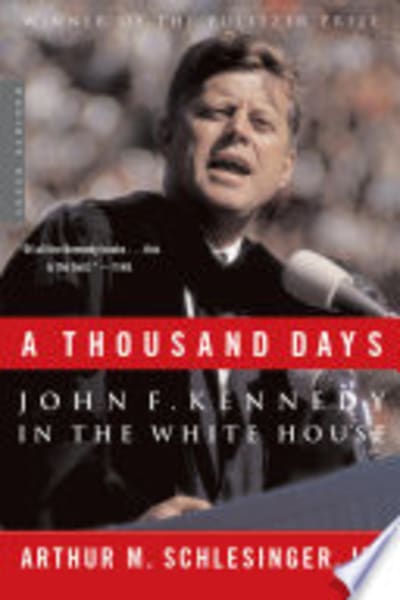
A Thousand Days: John F. Kennedy in the White House — Book Summary & Review
Last updated:
A Thousand Days: John F. Kennedy in the White House Summary
Schlesinger structures A Thousand Days around his dual vantage point—special assistant inside the White House and historian outside it—so the book keeps asking how decisions looked in the moment and how they read afterward. Early on, he frames the Kennedy presidency through the friction of ambition and improvisation, then revisits that frame across familiar landmarks and neglected operational messes. One recurring strength is Schlesinger’s ability to show how “process” became policy: the Bay of Pigs humiliation isn’t treated as a single blunder, but as a chain of assumptions, planning shortcuts, and political constraints that hardened into disaster. Another standout is the Civil Rights work, where Schlesinger ties presidential leadership to the slow grind of persuasion inside government rather than to a solitary moral awakening. He also keeps returning to the Skybolt missile mix-up—less famous than Cuba, but vivid in how it exposes the administration’s reliance on briefing accuracy and bureaucratic coordination. Even when you know the headlines, Schlesinger’s inner-circle reporting makes the timing feel real: who wanted what, which memo landed where, and how a “small” misread could become a public problem. The book’s limitation is equally clear: it’s loyal to Schlesinger’s own interpretation of Kennedy’s motives and competence, so readers looking for a fully adversarial reassessment of the administration—especially on sensitive foreign-policy choices—may find the tone too affectionate. If you want a cold, prosecutorial audit of every controversy, this is not that; it’s a meticulous defense of context, written by someone who lived inside the arguments.
Key Takeaways from A Thousand Days: John F. Kennedy in the White House
-
1
White House decision process: Schlesinger tracks how memos, briefings, and staff pressure convert into policy choices.
-
2
Bay of Pigs chain-of-assumptions: The failure is explained as accumulated misjudgments under political deadlines, not a single villainous act.
-
3
Civil Rights presidential persuasion: Kennedy leadership appears as sustained internal bargaining, not only public speeches or sweeping decrees.
-
4
Skybolt missile mix-up: A bureaucratic and intelligence coordination error becomes a case study in how credibility collapses fast.
-
5
Schlesinger’s inside/outside vantage: He uses eyewitness detail while still building historical context, shaping what feels “important.”
Who Should Read This
If you’re staring at a stack of political history books and want one that’s grounded in how White House machinery actually ran, Schlesinger’s account will satisfy you. Someone who recently learned the JFK story through headlines and wants the behind-the-scenes logic—especially around Bay of Pigs and Civil Rights—will likely stick with it.
Who Shouldn't Read This
If you want a strictly neutral, adversarial biography that treats Kennedy’s foreign-policy record like a courtroom exhibit, you’ll be frustrated by Schlesinger’s sympathy. If you dislike long, detailed administrative explanation—where the Skybolt mix-up gets real space—you may find the pacing heavy.
Editor's Verdict
The best part is Schlesinger’s operational realism, especially his treatment of the Bay of Pigs as a chain of planning and political constraints rather than a standalone tragedy. The real limitation is his consistently favorable framing of Kennedy’s motives and competence, which narrows how hard he’ll interrogate the administration’s choices. This hits hardest for readers who are mid-career and suddenly notice how their own work depends on briefings, timing, and coordination—then watch those same failures play out in 1961–1963.
Ready to read A Thousand Days: John F. Kennedy in the White House?
Get your copy on Amazon today.
A Thousand Days: John F. Kennedy in the White House — Frequently Asked Questions
About Arthur M. Schlesinger, Jr.
Arthur M. Schlesinger Jr. (1917–2007) was an American historian and public intellectual. He studied at Harvard and taught there, and he served in the Kennedy administration as a senior adviser and historian, giving him direct access to the White House and its decision-making. He is credible on Kennedy-era history through extensive archival research and firsthand involvement. He wrote A Thousand Days: John F. Kennedy in the White House (1965) and also authored The Vital Center (1949) and The Age of Roosevelt (1957–1960).