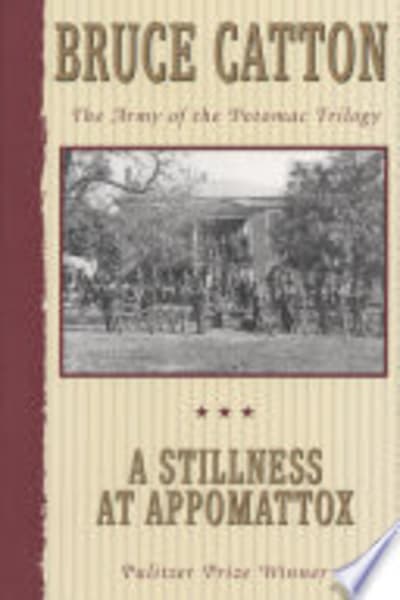
A Stillness at Appomattox — Book Summary & Review
by Bruce Catton
Last updated:
A Stillness at Appomattox Summary
In A Stillness at Appomattox, Bruce Catton’s final volume of the Army of the Potomac trilogy organizes the last year of the war around the grinding rhythm of pursuit—especially the way Grant’s armies convert battlefield gains into logistical inevitability. Catton doesn’t treat Appomattox as a neat climax so much as the end of a long, ugly arithmetic: Lee’s shrinking options, Meade’s cautious pressure, Sheridan’s cavalry speed, and the constant friction of hunger, fatigue, and broken command. The book leans hard on campaign-scale cause and effect, moving through set pieces like the Wilderness, the Bloody Angle, Cold Harbor, and the Crater, then tightening the screw through the months that lead to the first real collapse of Lee’s operational position. Catton’s voice is confident and old-school—he names the decisions, assigns responsibility, and keeps returning to how armies are sustained (or not) once the romantic fog clears.
What really stays with me is Catton’s handling of the “final year” as a sequence of near-misses. He repeatedly shows how one unit’s delay, one wagon train’s failure, or one missed chance to close a gap can decide whether a retreat becomes a rout or a reassembly. The climactic Appomattox material lands because Catton has already trained you to notice the small mechanics of encirclement and the sudden collapse of a plan. Still, A Stillness at Appomattox has an honest limitation: it assumes you’re comfortable with Civil War military geography and prior context from the trilogy. If you want a quick, character-first narrative with minimal battles-to-map translation, Catton will feel demanding and occasionally repetitive in his campaign framing—especially if you haven’t read the earlier volumes.
Key Takeaways from A Stillness at Appomattox
-
1
Army of the Potomac Trilogy framework: Catton closes the series by treating 1865 as a chain of operational consequences, not a single showdown.
-
2
Appomattox as arithmetic: the surrender reads as the end result of shrinking routes, not as a sudden moral awakening for either side.
-
3
Grant’s conversion of gains: Catton keeps emphasizing how battlefield movement is only meaningful when it can be sustained by supply and time.
-
4
Sheridan’s cavalry speed: cavalry actions matter less as drama and more as the mechanism for forcing Lee into worse and worse choices.
-
5
Lee’s collapsing options: Catton tracks how each retreat attempt reduces the next retreat’s room to maneuver, until the plan fails.
Who Should Read This
If you’re the kind of person who keeps circling back to Civil War campaigns because you want to understand how decisions cascade across weeks, read Catton. Someone who has grown tired of battlefield-only histories will appreciate how Catton ties tactics to logistics and movement through the final months.
Who Shouldn't Read This
If you want a light, standalone introduction to Appomattox with minimal prior knowledge, you’ll likely feel boxed in by Catton’s campaign assumptions. If you dislike dense operational detail and map-adjacent explanations, Catton’s emphasis on movement and command will frustrate you.
Editor's Verdict
Catton’s strongest move is his relentless linking of the Wilderness, the Bloody Angle, and Cold Harbor to the operational tightening that makes Appomattox inevitable in practice. The limitation is straightforward: this is not a beginner-friendly standalone, and it leans on prior familiarity with the trilogy and military geography. If you’re in the mood to earn your understanding—especially after you’ve read a few flashy Civil War narratives and want the harder, campaign-level truth—this is the book that hits hardest.
Ready to read A Stillness at Appomattox?
Get your copy on Amazon today.
A Stillness at Appomattox — Frequently Asked Questions
About Bruce Catton
Bruce Catton (1899–1978) was an American Civil War historian and journalist. He worked as a reporter and editor before turning to Civil War writing, using extensive primary sources and contemporary accounts. He is credible on Appomattox because he spent decades researching and synthesizing the campaign leading to the Confederate surrender. His notable works include The Army of the Potomac series and Mr. Lincoln’s Army.