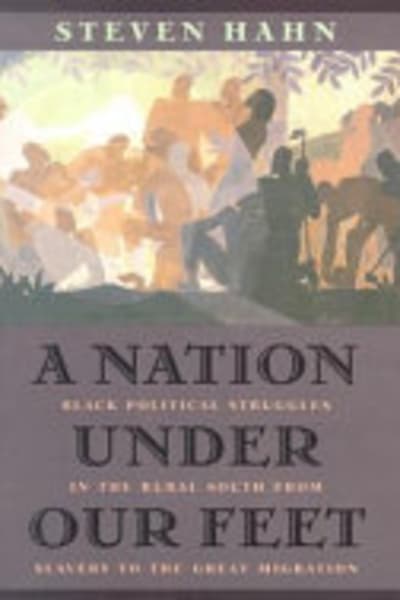
A Nation Under Our Feet — Book Summary & Review
by Steven Hahn
Last updated:
A Nation Under Our Feet Summary
In A Nation Under Our Feet, Steven Hahn builds his central framework around “political people” forming from rural kinship, labor, and communication networks, and he keeps returning to that idea across six generations after slavery. The book is organized to track how African-Americans practiced politics long before national voting power mattered, treating Reconstruction-era local contests, emigrationism, biracial electoral alliances, social separatism, and later migration as connected chapters of the same long project. Hahn’s most persuasive move is to zoom in on the everyday machinery of autonomy: how households and churches organized work, how messengers and newspapers tied distant communities together, and how kinship obligations became a kind of political infrastructure. He also argues that “self-governance” wasn’t a slogan but a repeated goal shaped by local conditions, from rural South disputes over authority to the defense and rebuilding of community after violent backlash. One concrete example that sticks is Hahn’s treatment of how grassroots mobilization and local leadership fed into later popular black nationalism, culminating in his discussion of Garveyism as an absorber and elaborator of earlier struggles. By the time Hahn reaches the twentieth century, his through-line starts to feel like a challenge to conventional timelines: civil rights consciousness didn’t simply arrive; it grew out of earlier experiments with power, belonging, and coalition-making. The limitation is that Hahn’s ambition—to cover a massive span and many regions while constantly theorizing “what politics is”—can leave readers wanting more sustained narrative depth on individual figures, especially if you prefer biography over social history.
Key Takeaways from A Nation Under Our Feet
-
1
Political people: Hahn uses this phrase to describe how African-Americans built collective power through daily social organization.
-
2
Kinship and labor: He treats household obligations and work routines as political tools, not background conditions.
-
3
Networks of communication: Local messengers, correspondence, and media links let distant communities coordinate strategies and share tactics.
-
4
Quest for self-governance: Repeated contests over authority show politics as a practical goal, shaped by violence and opportunity.
-
5
Garveyism absorption: Hahn argues later nationalism draws energy from earlier rural mobilizations and carries it northward.
Who Should Read This
If you’re wrestling with how “politics” can exist under extreme repression—say, in your own community’s fight over local power—Hahn’s account will feel eerily relevant. Someone who keeps bumping into the idea that black political consciousness begins only with national civil rights will get a real corrective from Hahn’s rural-to-urban through-line.
Who Shouldn't Read This
If you want a tight cast of characters and plot-forward storytelling, Hahn’s broad six-decade sweep and constant conceptual framing will frustrate you. If you skim academic argument and rely on “chapter summaries” to stay oriented, the book’s theorizing about what counts as politics may feel like heavy overhead.
Editor's Verdict
The best thing Hahn does is connect rural self-governance struggles to later twentieth-century politics, especially through his treatment of Garveyism as absorbing earlier grassroots patterns. The real limitation is that the book’s scale and theoretical insistence come at the cost of sustained, scene-rich biographies. This will hit hardest for anyone who reads history to understand how collective organizing actually gets built—particularly if you’re mid-career and questioning what “democracy” costs in places where it’s always conditional.
Ready to read A Nation Under Our Feet?
Get your copy on Amazon today.
A Nation Under Our Feet — Frequently Asked Questions
About Steven Hahn
Steven Hahn is an American historian and professor at the University of Pennsylvania. He specializes in U.S. history, especially slavery, the Civil War era, and African American life and politics. His scholarship is grounded in extensive archival research and has earned major academic recognition, making him credible to write about Reconstruction and Black freedom. He is the author of A Nation Under Our Feet and also wrote The Political Worlds of Slavery and A Nation Under Our Feet: Black Political Struggles in the Reconstruction Era.