A Midwife's Tale — Book Summary & Review
Last updated:
A Midwife's Tale Summary
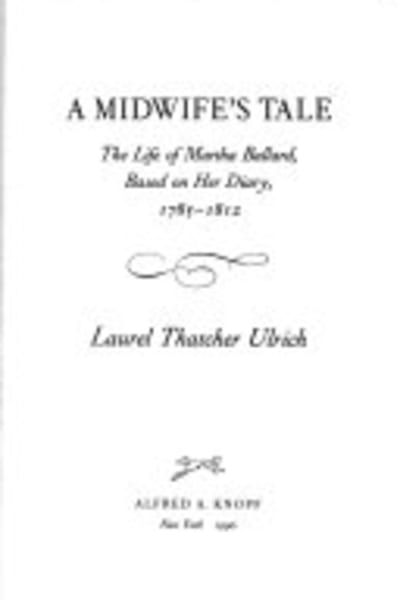
Laurel Thatcher Ulrich doesn’t treat Martha Ballard’s diary as quaint background; she builds the whole book around the diary’s daily structure and the interpretive problem of what “ordinary” work means, then tests that idea against eighteenth-century Maine life. The core payoff is Ulrich’s method: she reads Ballard’s entries with patience until they stop being mere notes about births and sickness and start functioning like evidence for how community labor, gender expectations, and timekeeping actually worked. One of the most memorable sections is the long attention to Ballard’s midwifery practice—how appointments, travel, and household coordination appear indirectly in the diary, even when Ballard isn’t explicitly “analyzing” anything. Ulrich also leans hard into the social fabric around midwifery: the diary shows who gets summoned, what counts as urgency, and how neighbors handle the aftermath of childbirth.
Ulrich’s argument is that we can’t understand early American society by focusing only on formal institutions or public records; the rhythms of care form a parallel system of knowledge. She repeatedly uses Ballard’s details to show how women’s work shaped community stability, from the practical logistics of attending births to the moral language and obligations that surrounded illness. If you’ve ever read history and felt it flatten people into symbols, Ulrich’s approach is a corrective: Ballard’s “small” entries become the scaffolding for a big claim about social order.
The limitation is real: this is biography-through-document analysis, not a dramatic narrative. If you want lots of quoted diary passages with constant plot momentum, you may find the interpretive pacing slow, and Ulrich’s scholarly framing can feel dense.
Key Takeaways from A Midwife's Tale
-
1
Martha Ballard’s diary becomes evidence, not ornament, letting Ulrich reconstruct community life through daily entries.
-
2
Midwifery as social infrastructure reframes childbirth care as community coordination, logistics, and obligations—not only medical events.
-
3
Reading “ordinary” work historically is Ulrich’s method: she treats routine labor as data for social structure.
-
4
Time and attendance patterns show how care traveled, revealing networks of trust and urgency in eighteenth-century Maine.
-
5
Ulrich’s documentary interpretation demands patience, rewarding close reading with a clearer picture of gendered knowledge.
Who Should Read This
Someone who keeps bumping into history books that focus on politics and laws but leaves everyday people feeling invisible should read this. If you’re trying to understand how communities actually run—through care work, not just institutions—Ulrich gives you a concrete model to follow.
Who Shouldn't Read This
If you want a fast, story-first biography with constant scene changes and lots of dialogue, this will test your attention. If you dislike academic historical method—footnote logic, interpretive caution, and argument-building from fragments—Ulrich’s approach will feel like homework rather than escape.
Editor's Verdict
Ulrich’s best move is her disciplined use of Martha Ballard’s diary to argue that women’s care labor underwrites community stability, not merely private life. The limitation is that the book is slow and documentary in texture, so readers expecting a plot-driven narrative may feel stalled. This hits hardest for anyone who’s ever felt burned out on “big history” and wants to see how the everyday becomes historical evidence the moment you slow down.
Ready to read A Midwife's Tale?
Get your copy on Amazon today.
A Midwife's Tale — Frequently Asked Questions
About Laurel Thatcher Ulrich
Laurel Thatcher Ulrich (born 1938) is an American historian and author. She earned a PhD in history from Harvard University and has taught at Harvard and the University of New Hampshire. Ulrich is credible on early American women’s and medical history, using extensive primary-source research in her work on childbirth and midwifery. Her notable books include A Midwife’s Tale: The Life of Martha Ballard, Based on Her Diary (1990) and The Age of Homespun: Objects and Stories in the Creation of an American Myth (2001).