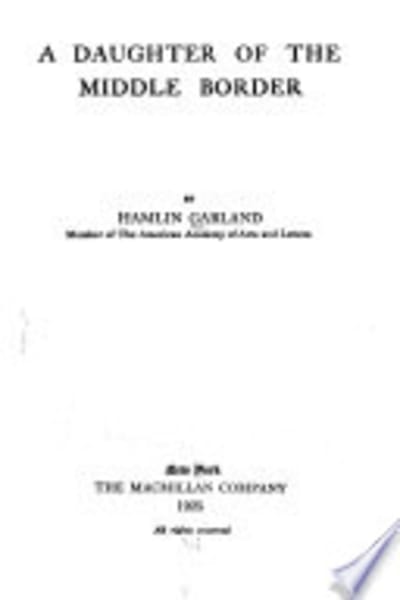
A Daughter of the Middle Border — Book Summary & Review
Last updated:
A Daughter of the Middle Border Summary
In A Daughter of the Middle Border, Hamlin Garland structures the book around a family-and-place argument: the “middle border” isn’t scenery, it’s a pressure system that shapes character, work, and moral choices. You feel Garland’s method early—he doesn’t ask you to admire pioneer life from a distance; he asks you to notice how geography, labor, and inheritance grind themselves into daily decisions, especially for women. The narrative focus lands on a daughter’s experience, but the engine is bigger than romance or even individual struggle: Garland keeps returning to how writing and memory are forms of accounting, where what a person endures becomes a kind of evidence.
One of the clearest concrete anchors is the book’s repeated attention to frontier routines—planting, hauling, sickness, and the constant calculation of “enough.” Garland also threads in correspondence and authorial reflection, so the biography reads less like a sealed life story and more like an ongoing conversation about what should be preserved and what gets mythologized. Even when the prose turns lyrical, Garland stays tethered to craft: he shows how a family narrative becomes a public claim about American identity.
Garland’s limitation is also part of the design: if you want a clean, plot-forward biography with modern pacing, you may find the book’s emphasis on social atmosphere and moral interpretation slow. It’s also not a straight survey of Garland’s entire career; it’s a targeted portrait, so readers hoping for comprehensive literary history will feel boxed in.
If you’re willing to read patiently, A Daughter of the Middle Border is Garland at his most earnest—arguing, through one daughter’s life, that place and labor are never background; they’re authors, too.
Key Takeaways from A Daughter of the Middle Border
-
1
Middle Border framing: Garland treats the region as a force that edits character through work, weather, and family obligation.
-
2
Frontier routines: daily tasks like planting and sickness are used as evidence for how values get formed under strain.
-
3
Correspondence method: letters and documentary textures blur biography and literary argument, making memory feel accountable.
-
4
Women’s inheritance pressure: the daughter’s role shows how “choice” narrows when survival and duty dominate options.
-
5
Garland’s preservation problem: the book keeps asking which parts of a life become “truth” and which become convenient myth.
Who Should Read This
Someone who’s stuck in the familiar loop of “career success” but feels their real life is being decided by older forces—family, place, economics—should read this. If you’ve been craving a biography where the setting has teeth and the interpretation is part of the story, Hamlin Garland will fit.
Who Shouldn't Read This
If you want a fast, plot-driven biography with frequent, decisive turning points, A Daughter of the Middle Border will frustrate you with its atmosphere-first pacing. If you expect a comprehensive survey of Garland’s entire literary output, this book’s narrow focus will feel like an incomplete map.
Editor's Verdict
The single best thing this book does is turn the middle border into an explicit explanatory framework, using frontier routines and documentary textures to show how a daughter’s life is shaped by labor and obligation. The real limitation is that the biography leans hard on social interpretation and recurring motifs, so readers who crave momentum and plot payoff may feel stalled. This hits hardest for anyone in the middle of a personal reinvention—especially if you’re trying to separate your own choices from the old rules you inherited.
Ready to read A Daughter of the Middle Border?
Get your copy on Amazon today.
A Daughter of the Middle Border — Frequently Asked Questions
About Hamlin Garland
Hamlin Garland (1860–1940) was an American writer and social critic from the Midwest, born in Wisconsin and raised in Iowa. He drew on firsthand experience of rural life on the “middle border” to write about farmers, land, and changing economic conditions. His credibility comes from his direct upbringing in the region and his long career documenting its realities. Other notable works include Main-Travelled Roads (1891) and A Son of the Middle Border (1917).