21 Lessons for the 21st Century — Book Summary & Review
Last updated:
21 Lessons for the 21st Century Summary
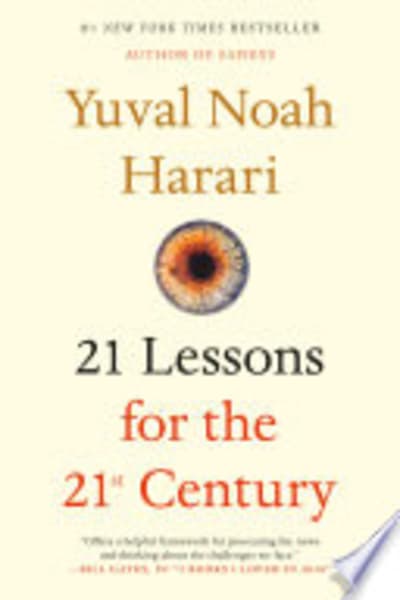
In 21 Lessons for the 21st Century, Yuval Noah Harari organizes the book as a sequence of numbered “lessons,” using recurring big claims about information, power, and prediction to interpret everything from liberal democracy to climate politics. The through-line is Harari’s insistence that modern life is run by systems that people only half-understand: data flows, incentives, and institutions shape reality long before you feel them as “events.” One of his most pointed moves is the diagnosis of censorship-by-distraction—he argues governments and elites can avoid classic suppression by flooding the public with disinformation, outrage, and noise, so citizens stop coordinating around shared facts. Harari then keeps stress-testing the same idea across domains: if your attention is the scarce resource, then whoever manipulates attention can rewire politics, markets, and even conflict.
Harari also spends serious time on whether liberal democracy is in trouble for structural reasons, not just because of bad actors. He frames “fake news” as less a quirky internet problem than a symptom of a deeper mismatch between how humans make decisions and how algorithmic media distort incentives. The book’s section on “God” and the question of whether religion is “back” feels like Harari is arguing for a change in function rather than a change in belief: religious language can return as a branding tool for identity and meaning.
When Harari turns to geopolitics—“Which civilisation dominates the world – the West, China, Islam?”—his predictions are bold and often phrased like inevitabilities, which is both the appeal and the risk. Harari gives you enough historical scaffolding to sound plausible, but he doesn’t slow down to show all the competing models he’s rejecting. If you want careful sourcing, counterarguments, and footnoted forecasts, Harari’s style will frustrate you. Still, if you’re trying to think clearly about the present without drowning in headlines, Harari’s lessons land with a bracing urgency.
Key Takeaways from 21 Lessons for the 21st Century
-
1
Censorship by distraction: Harari argues control can come from drowning people in disinformation and noise, not from banning information.
-
2
Fake news as incentive failure: He treats misinformation as a system output of attention economics, not a purely moral problem.
-
3
Liberal democracy in crisis: Harari frames democratic breakdown as structural—citizens can’t coordinate on facts while institutions lose trust.
-
4
God as a functional return: He suggests religion reappears less as doctrine and more as a tool for identity, meaning, and political legitimacy.
-
5
Civilizational dominance: Harari uses broad comparative claims to argue power will track who can steer global narratives and technologies.
Who Should Read This
If you’re doom-scrolling politics and can’t tell which stories are manipulation versus information, you’ll get a useful framework for sorting incentives and attention. Someone who feels exhausted by “breaking news” noise and wants a coherent way to think about democracy, war risk, and technology will likely stick with Harari.
Who Shouldn't Read This
If you need rigorous, evidence-heavy forecasting with transparent methodology, Harari’s confident leaps and big-picture tone will feel sloppy. If you prefer quiet, character-driven nonfiction or tightly argued case studies, the numbered lesson structure will feel like constant thesis statements with limited payoff.
Editor's Verdict
The best part of 21 Lessons for the 21st Century is Harari’s repeated, testable focus on attention and information—his “censorship by distraction” idea is the kind of lens you can use the next time you see political outrage manufactured. The limitation is that Harari’s predictions are often stated with too much certainty and too little demonstration of competing evidence, which weakens the credibility of some conclusions. This book hits hardest for anyone early in a career who’s about to choose a field or ideology and needs a blunt map of how media, tech, and power interact right now.
Ready to read 21 Lessons for the 21st Century?
Get your copy on Amazon today.
21 Lessons for the 21st Century — Frequently Asked Questions
About Yuval Noah Harari
Yuval Noah Harari is an Israeli historian and author. He studied at the Hebrew University of Jerusalem and earned a PhD in history at Oxford University. He teaches and writes about how technology, politics, and human societies evolve, making him credible to discuss the future and its implications. His widely cited books include Sapiens: A Brief History of Humankind and Homo Deus: A Brief History of Tomorrow, in addition to 21 Lessons for the 21st Century.