What Is Man? and Other Essays — Book Summary & Review
by Mark Twain
Last updated:
Public domain via Project Gutenberg — free and legal.
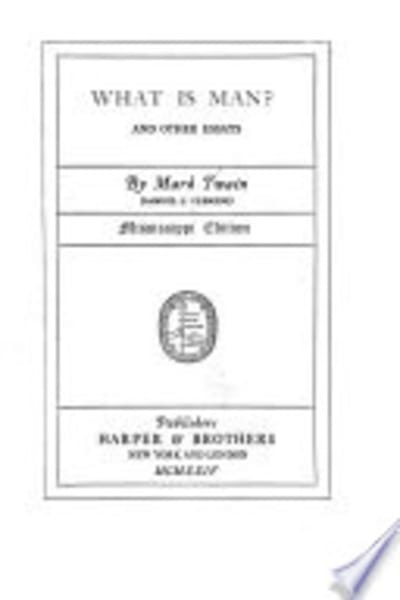
What Is Man? and Other Essays Summary
Mark Twain’s What Is Man? and Other Essays is a grab bag of philosophy and culture pieces, but the framing question in “What Is Man?” keeps snapping everything back into focus: what counts as human when you strip away manners, religion, and self-congratulation. Twain’s method is to poke at grand definitions until they either collapse or reveal their hidden assumptions. In “What Is Man?” he treats “man” less like a finished category and more like a claim people keep making—then he attacks the flattering parts first, especially the idea that we’re uniquely designed for moral greatness. The essay doesn’t read like a tidy argument; it reads like an intellectual prank with a point, and Twain’s point is that the species label is doing more work than the facts.
A different kind of argument shows up in “As concerns interpreting the Deity,” where Twain’s sarcasm turns into a kind of logic test: if people can interpret God in mutually incompatible ways and still call it certainty, then certainty is not the same thing as truth. Elsewhere, “English as she is taught” and “A simplified alphabet” take aim at the comforting fantasy that our systems are rational simply because they’re traditional. Even when Twain shifts topics—tobacco in “Concerning tobacco,” bicycles in “Taming the bicycle,” or the literary afterlife in “Is Shakespeare dead?”—the same skepticism drives him: human institutions are stubborn, but they’re not sacred.
The essays are also historical and personal in odd flashes, like “The turning-point of my life,” where Twain remembers decisions more than doctrines. Limitation: this collection won’t satisfy readers wanting one sustained philosophical thesis with a consistent conclusion; it’s episodic, and some essays feel like sketches rather than arguments. If you need coherence more than wit, you’ll get impatient with Twain’s bouncing attention.
Key Takeaways from What Is Man? and Other Essays
-
1
What Is Man? frames humanity as a claim people defend, not a stable fact, and Twain exposes the flattering assumptions behind it.
-
2
As concerns interpreting the Deity treats religious certainty as a testable behavior, showing how incompatible interpretations survive by social habit.
-
3
English as she is taught argues that instruction often protects tradition over clarity, using spelling as a symbol for needless confusion.
-
4
A simplified alphabet proposes reform by implication: if the goal is communication, the system should serve sound, not vanity.
-
5
Is Shakespeare dead? treats authorship myths as cultural needs, where doubt spreads because certainty is convenient.
Who Should Read This
Someone who’s tired of being sold a single worldview and wants a writer who attacks definitions from multiple angles should read this. If you’re stuck in debates—workplace, family, or online—where everyone claims “obvious truth,” Twain’s essays will give you sharper questions to ask.
Who Shouldn't Read This
If you want one continuous philosophical argument from start to finish, you’ll find this collection frustratingly uneven. If you’re looking for modern, neatly organized nonfiction with smooth transitions, Twain’s essay-hopping style will feel like deliberate clutter.
Editor's Verdict
Twain’s best move is using “What Is Man?” as a recurring demolition tool, then letting essays like “As concerns interpreting the Deity” show how certainty can be manufactured. The limitation is structural: the book is a set of separate targets, so there’s no single argument spine to carry you through. Anyone in a mid-life phase of questioning inherited beliefs—especially after a year of political or religious argument fatigue—will feel the sting most strongly.
Ready to read What Is Man? and Other Essays?
Get your copy on Amazon today.
What Is Man? and Other Essays — Frequently Asked Questions
About Mark Twain
Mark Twain (Samuel Langhorne Clemens, 1835–1910) was an American writer and journalist. He grew up in the Midwest, worked as a printer and riverboat pilot, and later traveled widely, experiences that shaped his skepticism and social commentary. His essays in What Is Man? and Other Essays reflect his sustained engagement with human nature, morality, and society. He is credible on this topic through his long career writing observed, critical commentary. Other notable works include The Adventures of Tom Sawyer and Adventures of Huckleberry Finn.